New federal and state rules on eligibility of public benefits to affect undocumented, non-citizen immigrants from Jan. 1, 2026

SAN FRANCISCO — Under the new federal and California rules, Medi-Cal, California's Medicaid program, and CalFresh, California's Supplemental Nutrition Assistance Program (SNAP) which is formerly known as Food Stamps, will make changes on eligibility and coverage. Some current recipients of both programs including undocumented and non-citizen immigrants might lose their benefits under the new policies.
San Francisco City leaders urged residents who need critical public benefits to apply or renew their applications prior to January 1, 2026.
San Francisco Human Services Agency (SFHSA) Executive Director Trent Rhorer hosted a virtual press conference on November 20 and was joined by Mayor Daniel Lurie and the San Francisco Department of Public Health Director Daniel Tsai to provide updates on the public benefits eligibility changes in 2026.
H.R.1, One Big Beautiful Bill Act, was introduced by Representative Jodey C. Arrington, R-Texas, in May and passed in July 2025. President Donald Trump signed the bill into law on July 4, 2025, Independence Day.
The bill increases work requirements, 80 hours a month, for certain SNAP recipients who are aged 19 - 64 and raises the age for those who must meet the additional work requirements to 65 years old and younger, while these requirements currently apply to adults who are 55 years old and younger. The SNAP is managed by the U.S. Department of Agriculture.
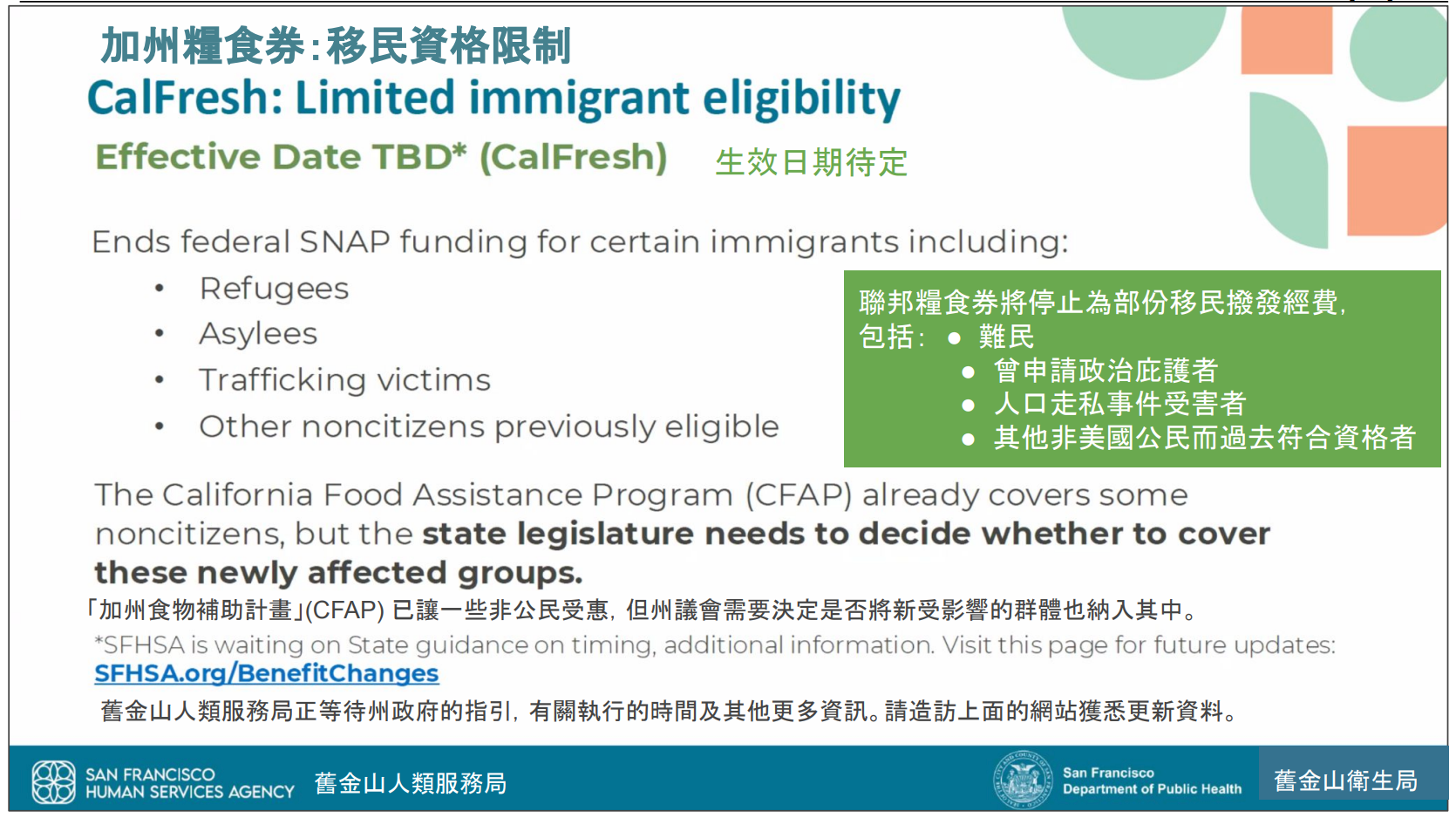
H.R. 1 also eliminates SNAP eligibility for certain individuals who are classified as an alien under federal law legally present in the United States, including those who have qualified for conditional entry under the asylum and refugee laws or based on urgent humanitarian reasons, like survivors of domestic violence or human trafficking.
The bill maintains SNAP eligibility for individuals who are U.S. citizens and lawful permanent residents commonly known as Green Card holders with exceptions.
Medi-Cal, as the California's Medicaid program, is jointly funded by the state and federal governments, with federal covering a larger share and the state covering the rest. Additional funding comes from local government contributions.
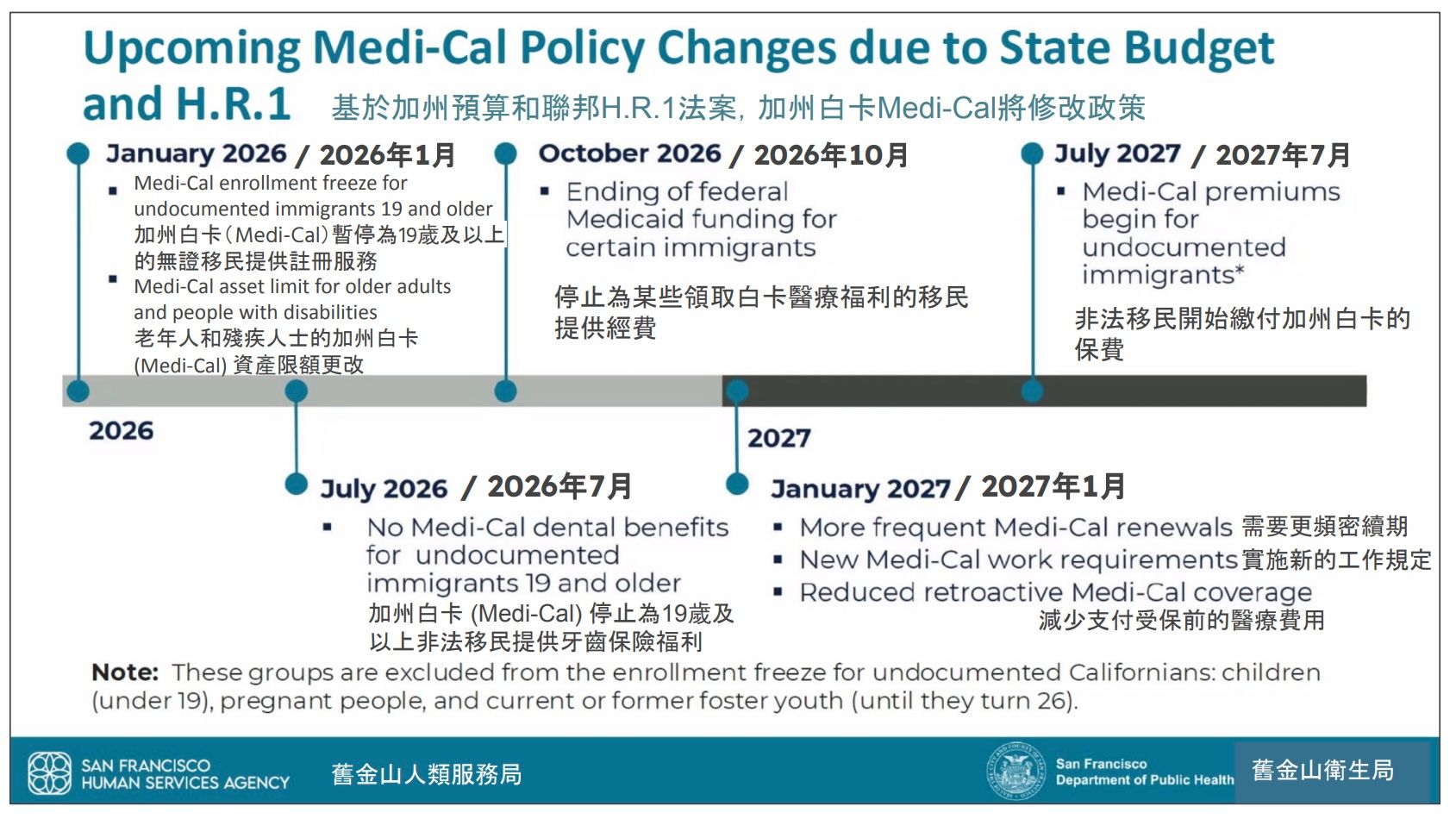
The H.R.1 bill also makes changes on the Medicaid program eligibility by introducing work requirements for certain individuals, requiring more frequent eligibility checks, and restricting coverage for certain immigrants who previously qualified and lawfully present in the United States including immigrants who became legally in the country through asylum and human trafficking programs. The changes related to the Medi-Cal program will be in effect starting January 2026.
According to the data provided by the SFHSA, currently there are 221,000 individuals and 148,000 households on Medi-Cal coverage in San Francisco, 112,000 individuals and 82,000 households on the CalFresh food assistance program.
When new federal and state rules are implemented from January 1, 2026 through later 2027, 25,400 - 50,000 San Francisco residents could lose Medi-Cal coverage by the end of 2027 representing 12% - 23% of the program recipients.
With respect to the CalFresh/SNAP program, about 21,080 residents, 20% of CalFresh recipients, are at risk of losing benefits if they don’t meet work rules, according to SFHSA.
Although some new rules begin to be effective starting January 1, 2026, healthcare coverage and food assistance benefits might still be eligible to current recipients if they apply or renew for the 2026 programs by the end of this year on December 31, 2025.
The latest federal government shutdown lasted for 43 days from October 1 to November 12. The U.S. Department of Agriculture had delayed issuing November's SNAP benefits to 41.7 million recipients across the nation. The SNAP assistance has been fully restored after the shutdown ended.
In early November before the federal government reopened for services, Lurie announced to authorize the use of $9.1 million from the city's reserved fund and to create a public-private partnership with Crankstart Foundation which would provide matching funds.
With the partnership in place, $18 million one-time emergency aid strategy, GiveCard, had been distributed to the City's 82,000 households of the CalFresh (SNAP) program recipients.
"We know that federal changes to benefits eligibility are creating concerns among San Franciscans who rely on those public benefits including the nearly 112,000 residents who received SNAP and the 261,000 who are enrolled in Medicaid," said Mayor Lurie at the virtual press conference.
"That's why we want to work with our community and our media partners to help people prepare for what's ahead," Lurie said. "To be clear, in this city, we will not stand by. We will come together as we do in difficult times, just as we did in response to the impacts of the federal shutdown on SNAP benefits."
"Doubling our impact, which ensured every San Franciscan receiving SNAP benefits, had the support they needed to buy groceries for the full month of November, already more than 53,000 households have activated their prepaid grocery cards with nearly $12 million distributed," Lurie added.
Lurie encouraged recipients of both programs to enroll in the benefits now that they are eligible for before January 1. "We want people to know we are on their side. We will continue doing what it takes to ensure San Franciscans remain safe and healthy," said Lurie.
Over the past several months, the San Francisco Human Services Agency (SFHSA) and the San Francisco Department of Public Health (SFDPH) have collaborated to engage with community members, community-based organizations, and other City agencies to share updates on upcoming benefit changes.
"We are the safety net provider. For the City, that's the San Francisco General Hospital, primary care clinics, behavioral health services and other public health," Daniel Tsai, Director of SFDPH, said at the virtual press event.
"We want to make sure that as many people as possible maintain and have coverage and access to healthcare and food because we know those are critical things to people's well-being and their health outcomes," said Tsai. "Our providers and others try to do everything possible to navigate and help mitigate the impact on the people we serve in San Francisco."
SFHSA Director Rhorer highlighted the upcoming changes and impacts by the new federal and state rules on public assistance programs in 2026 and following years including enrollment restrictions for undocumented residents.
"Undocumented Californians aged 19 and above will no longer be eligible for full healthcare coverage through Medi-Cal," said Rhorer. However, if the same group of undocumented Californians, aged 19 and above, already have the Medi-Cal coverage, they will remain eligible for full healthcare coverage as long as they follow the recertification instructions.
Therefore undocumented adults currently without Medi-Cal benefits need to apply for full Medi-Cal coverage before January 1, 2026. Starting July 1, 2026, all undocumented adults with Medi-Cal coverage will lose dental benefits.
On October 1, 2026, individuals with certain immigration statuses will no longer qualify for full Medi-Cal and CalFresh(SNAP) programs at the federal level under the new rules in H.R.1.
Rhorer said California would still provide full-scope Medi-Cal (all regular medical services, not just emergencies), but dental care that is not emergency would not be covered for the affected groups including refugees or asylees, humanitarian parolees, human trafficking and domestic violence survivors.
On the CalFresh (SNAP) program, immigration status eligibility changes for undocumented and non-citizen immigrants including refugees, asylees, survivors of human trafficking and domestic violence will also be applied.
The California Food Assistance Program (CFAP) already covers some non-citizens that are not federally funded, but the state legislature needs to decide whether to cover these newly affected groups for the CalFresh (SNAP). SFHSA is still waiting for State guidance, said Rhorer.
Rhorer reminded 82,000 households, who received the one-time emergency prepared grocery cards when SNAP benefits were delayed for the month of November during the federal government shutdown, to activate their cards for food assistance by the end of this year, December 31, 2025, and use the card funds by deadline, March 31, 2026.
"About 65% have activated their cards, accessing over $11.4M in support but certain communities have a lower take up rate including Spanish and Filipino speakers and residents of Civic Center, Tenderloin, Mission District, Bayview, and Downtown," Rhorer said.
- Asian supermarkets are booming in the San Francisco Bay Area with intense industry competition
- Architect Dartmond Cherk: Taking away this symbolic bridge would deflate the standing of the Chinese community in San Francisco
- Our Mission and Policy
- San Francisco: Kearny Street, between Clay and Washington streets, to be fully closed Aug. 1-2 and Aug. 8-9; Broadway Tunnel closed Aug. 15-16
- Carla Lee Hurley and Kirk Yin, 2 bilingual and community-oriented police officers, promoted to Captains in SFPD
- Over 15,000 signatures submitted, San Francisco citywide voters might have a chance to reopen Upper Great Highway
- 4-block Red Lane pilot project on Ocean Avenue presented, local merchants and residents oppose and ask for an immediate halt
- Chinese Newcomers Center holds annual food giveaway in San Francisco Chinatown for 5,000 seniors and low-income families citywide