Setting foot in the United States of America - 6 Decade in a Glimpse (Pius Lee Autobiography 2)
Chapter 3: Setting foot in the United States of America
On May 1st, 1963, I had a few hundred dollars in my pocket. We were on the American President Line and after spending 18 days on rough sea, we finally arrived in San Francisco.
While we did not have any relatives, our village compatriot Mr. Lam Chi Chiu was waiting at a pier and gave us a warm welcome. After we got off the ship, we were driven directly to a nursery in Santa Clara run by Mr.Lam.
We stayed at his nursery for about a month while my wife and I took a train to San Francisco looking for work. My older sister Linda worked at the nursery. Later Mr. Lam's younger brother married my sister. They had three sons and one daughter and lived a happy life.
My wife found a job at a sewing factory, and later on got a job at the accounting department in the British Motor Company. I was a teller at the San Francisco Saving & Loan in San Francisco Chinatown. My wife and I lived in a studio not far from Chinatown.
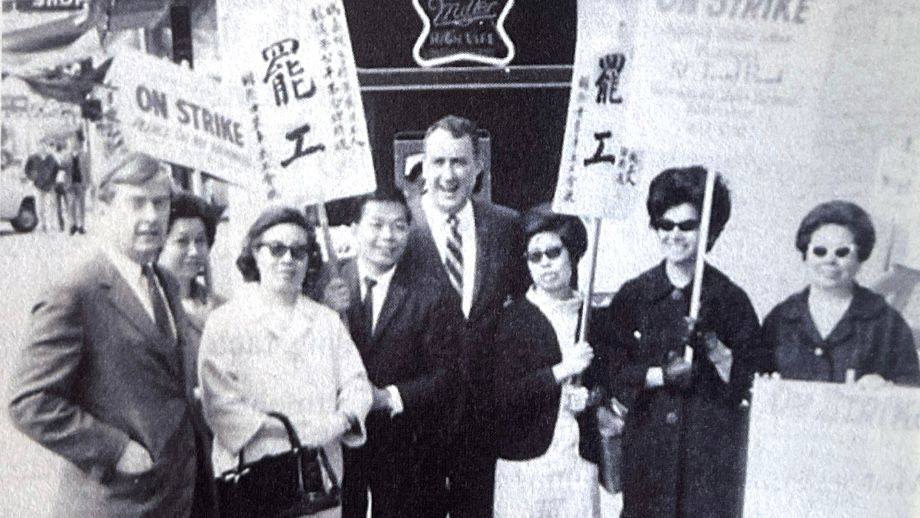
About two years later, a friend helped me to get a job as a union representative for a seamstress union, fighting for minimum wage and working conditions. My income was low but life was stable. In those days, Chinatown had a few dozen sewing factories.
The late President Lyndon Johnson launched his Great Society legislation. Five communities in San Francisco, Chinatown included, were identified as low-income areas qualified for federal funding. Chinatown would receive $500,000. This new program enabled me as a seamstress union representative to be appointed by former San Francisco Mayor John Shelley as a member of the Economic Development Committee in Chinatown. It was the first time in my life that I became a city appointee and came in contact with many political figures.
In 1966, I became the chair of this committee. With the $500,000 that we fought for, we set up job training classes, created job opportunities, offered funding assistance, opened an English language center for the elderly and new immigrants, which has become a City College language course. These programs are now being offered from what is now at Self-Help for the Elderly, Community Youth Center and City College in Chinatown.
I felt deeply that for the Chinese community to fight for their rights, they need to get involved in politics.
Politicians care about votes and campaign funding. In those days, I did not have any money and I was not an U.S. citizen. To realize my dream, I planned to go to law school in the evening, but I couldn't afford to pay for the law school fees. So I went to a real estate school. I chose a real estate business in San Francisco.
In San Francisco, you had to pay for your own tuition for the real estate class. I could not afford it either. Luckily, I knew of a real estate owner, who was willing to pay for my tuition in return for my commitment to working for him for one year. After graduation, I did work for him for about a year.
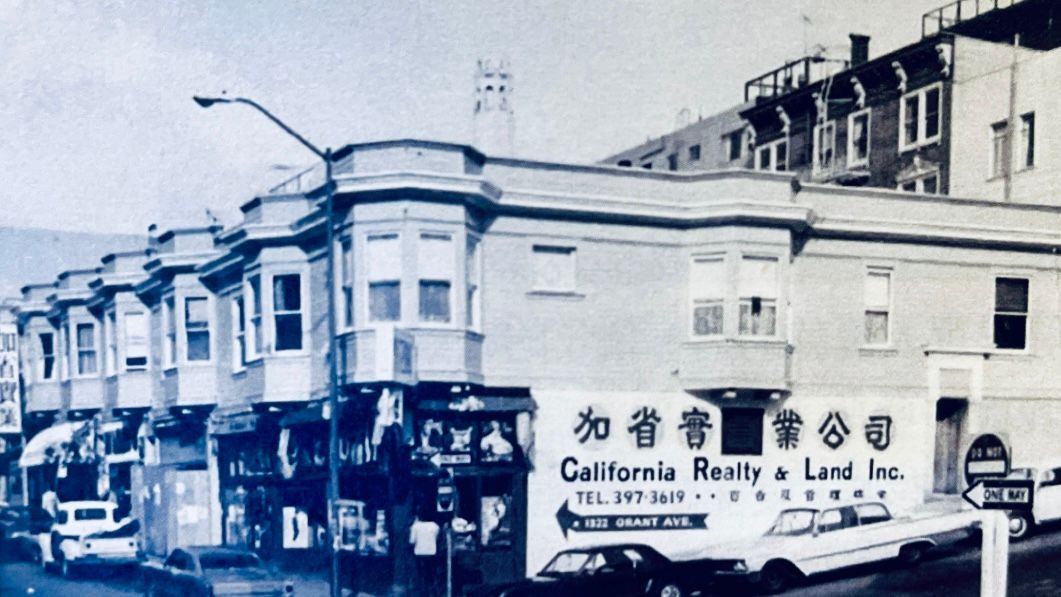
In 1968, I received my real estate license and opened my own company California Realty & Land Inc. It is still in business to this day.
My oldest son Lawrence and my daughter Judy were born after I moved to the United States. My son is also in the real estate business, and my daughter is an attorney working at the Santa Clara District Attorney Office.
Chapter 4: Got involved in real estate and started a real estate business
While I was working at the bank, and as the Chairman in Chinatown Economic. Development Center, I came to know quite a number of well off customers. This connection helped me connect with many potential clients in my real estate business later on.
Property prices were cheap in those days. If you had a stable income, after you and your wife both worked for three to five years, you should be able to take care of your first down payment (usually 10 to 20 percent of the property value), own your house with monthly payment. The buyer could use the Second Loan from the seller if necessary.
In those years, many Chinese immigrants had certain levels of savings. They bought entry-level properties. Buying properties was a trend.
For example, in the 1960s, in the Richmond and Sunset Districts, the asking price of a residential house of about 1,500 square feet was only in the $20,000-plus range. Fifty years later, no one could imagine that the market price of a residential property of the same size is over $1 million.
In 1968, the California Realty & Land Inc. that I founded was first located on Columbus Avenue near the Chinatown-North Beach border. This 300 square feet office kicked off the beginning of my real estate business.
Although I was the only person running the company, I was ambitious. A lot of people from Hong Kong came to San Francisco with visitor visas but secured immigration through investment. I understand that many Chinese people save enough money with a stable income and their dream is to own their home.
Since we spoke the same language, my company's business quickly moved in the right direction. I began to feel confident and had a high expectation of my real estate business.
All along, I always encourage everyone that if conditions allow, consider buying property for residential or for investment purposes. In my view, San Francisco is a peninsula. Buildings have height limits. Land resources are in extremely short supply. However, as long as the investment is prudent, it will be a profitable business without losing any money.
In the past, a seamstress took my advice and invested $40,000 in an income-producing property. This property's market value is worth over $2 million today.
The key to real estate investment is location, the price may be on the high side, or has contract restriction. Income generated in the short term may be less than ideal. But it will pay off handsomely in the long term. For those who have income and the means as investors, it is the best way to offset tax deduction.
In 1975, I paid $270,000 for a four-story house in the Marina residential district facing Golden Gate Bridge with only 10% down and the owner gave me a second loan of 10%, so I was able to buy it. This neighborhood commands a beautiful view. Currently all these homes on Marina Blvd. are sold for over $5 million.
Weather, location, people, plus my keen observations and hard work in the real estate market, my business kept coming. Between 1976 and 2015, the real estate market was booming, California Realty & Land Inc. hired more than 50 sales agents, with an average of more than one transaction of sale a day.
My business partner Dr. William Breall and I bought half of a block of 1300 Grant Avenue in Chinatown. I moved my office from Columbus Avenue to the new location.
Dr. Breall had a commercial building with residential units for sale but was not able to sell it. I proposed to help him to put it on the market. He only gave me a week's time. I didn't expect that the property would be sold and the contract signed in three to four days. Dr. Breall was excited and felt confident that I could be his business partners to buy and sell properties as a team. With hard work, he and I made over $1 million each for a few years. To this day, we are still close friends.
My company expanded to the point that I specifically bought a new Rolls Royce to drive customers from Hong Kong to locations during real estate inspection. Through word of mouth, this arrangement helped me impress my customers.
Since 1975, I have already begun to get involved in politics, helping candidates running for presidents of the United States, governors, and mayors to raise funds.
In those days, there was no campaign funding limit. So, some high-income friends and I individually paid $5,000 to $10,000 to different candidates.
Now, the new rules impose limits on political donations. For example, donations for a mayoral candidate in San Francisco cannot exceed $500 and must be paid for by personal checks and no company checks. This rule applies to candidates in presidential, governor, mayor and Board of Supervisors races.
In addition to real estate transactions, I began converting and renovating old properties, then resold them or leased them as commercial units, making handsome profits. My investment partners also made good returns for their investments. I will provide more details later about three properties in Chinatown, 1249-1251 Stockton Street, 850 Stockton Street, 900-930 Stockton Street, another one is 965 Geneva Blvd. in San Francisco.
After I went into the real estate business, I have always encouraged Chinese people to buy properties. In the 1970s, Mr. Hung from Hong Kong visited San Francisco and found me in a newspaper advertisement.
He called and asked me about real estate investment. It turned out he was Mr. Hung, the company owner who gave me a job in Hong Kong. He wanted to immigrate to the United States through investment. I helped him to invest in several commercial buildings and arrange an attorney to help him process the immigration visa requirement.
Eventually Mr. Hung received a great return for his investments for over $10 million. His children were able to immigrate to the United States. They eventually had their career and lived a happy life. I really appreciate Mr. Hung for taking good care of me while I was in Hong Kong. He not only gave me a job opportunity, and even gave me business later on in San Francisco, I am so glad that I also helped him successfully invest in real estate and make a great profit of over $10 million.
( To be continued in Issue 188 )
Editor's Note: Community leader Pius Lee retires in 2024 after advocating for the community in many ways for 60 years. He has recently released his autobiography book, 6 Decades in a Glimpse, as his personal memoirs for his friends and families, not for sale. Mr. Lee shares his book with community members to be reprinted in Wind Newspaper's weekly issues starting #186 in April 2024.
- Voters in 5 counties of the San Francisco Bay Area to decide whether to raise the sales tax by 0.5% or 1% for 14 years to fund public transit
- Opinion: A voice for every community and the next generation of San Francisco
- Opinion: Let’s vote yes on 5-county Bay Area regional measure and San Francisco Prop H for clean, safe, and reliable public transit!
- California leads in dedicating September 25 as annual Dolly Parton Day in honor of the American icon’s legacy of love
- Governor launches new era of CalKIDS accounts working with federal to maximize free funds for all children in California
- 5 of 10 local measures in San Francisco authored by Mayor Lurie to amend City Charter and secure funds for SFMTA
- Opinion: Vote no on Prop H — small businesses cannot pay more
- Prop G gets a second chance for San Francisco voters to decide the fate of the Upper Great Highway in the November election