San Francisco fails to preserve the historic Portsmouth Square pedestrian bridge in Chinatown, demolition to begin

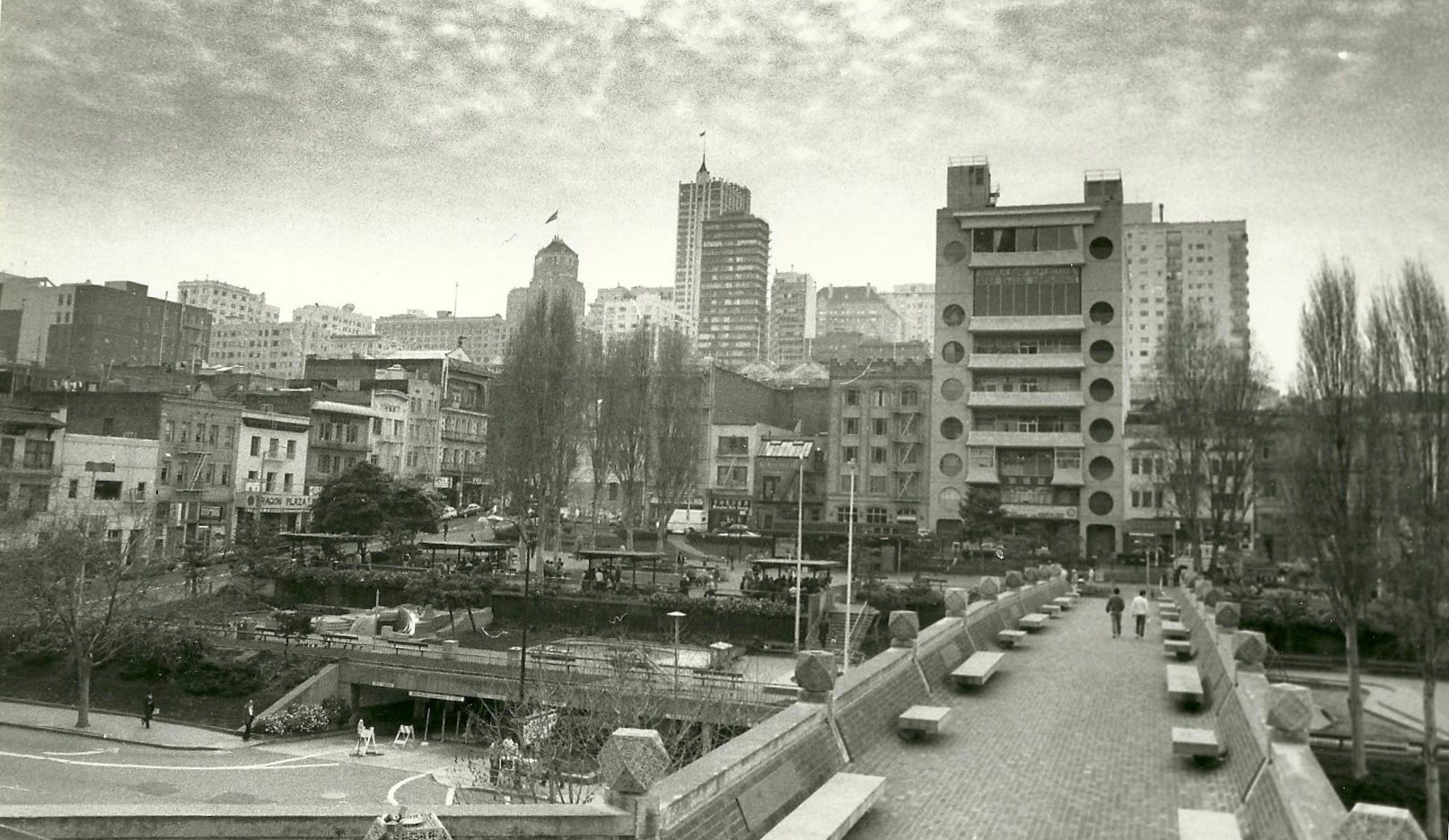
SAN FRANCISCO — San Francisco began closing Portsmouth Square Park to public use on June 10 for the renovation project. Many members of the Chinese Community remain outraged by the city's decision to overlook their opposition to removing the historic pedestrian bridge connected to the park and failing to preserve a landmark structure in Chinatown.
After the city announced the construction schedules for three major renovation projects in Chinatown, Portsmouth Square, Chinatown Public Health Center and Public Library Chinatown Branch, to begin in June, complaints from community members poured into Wind Newspaper asking to voice their opposition to the city.
According to the city's latest schedules, the Chinatown Public Health Center, located at 1490 Mason Street above the Broadway Tunnel, closed on June 5, 2026 for two years to undergo seismic and medical facilities upgrades. These upgrades are funded by the voters-approved Healthy, Safe and Vibrant Bond in 2024 with a budget of $76.1 million. During construction, the health center's services will temporarily be relocated to the Chinese Hospital at 845 Jackson Street starting June 22, 2026 until 2028.
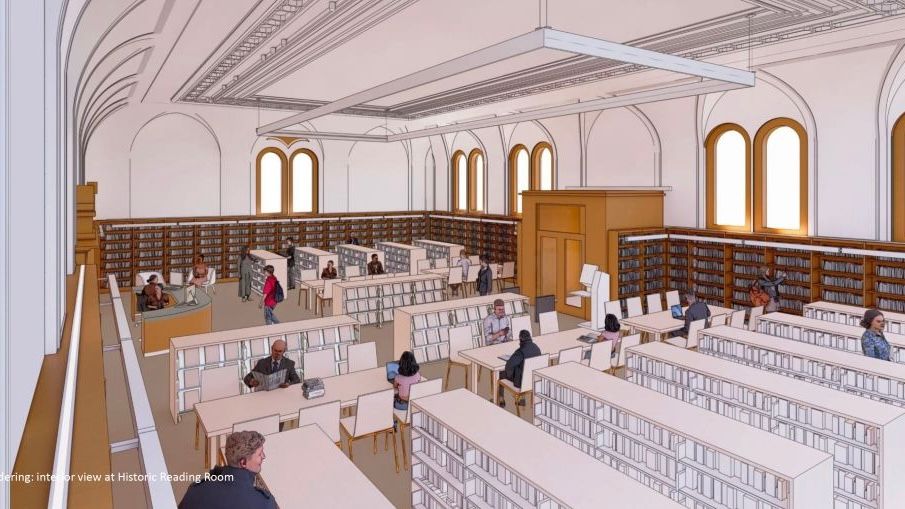
The Chinatown Branch Library, built in 1921 at 1135 Powell Street, will also be closed for renovation and expansion in summer 2026 with a budget of $38.7 million. The city has not yet released exact closing dates. The Public Library has selected a temporary Chinatown Branch located at 950 Grant Avenue.
Portsmouth Square Park, a 57,516-square-foot park located at 733 Kearny Street is scheduled to close on June 10 for two years. The renovation, costing $73 million, is primarily funded by the 2020 Health and Recovery bond with additional funds from developer impact fees, the Downtown Park Fund, Sustainable Chinatown, a $6 million state budget allocation secured by former Assemblymember Phil Ting, and a $1 million state budget allocation from State Senator Scott Wiener.
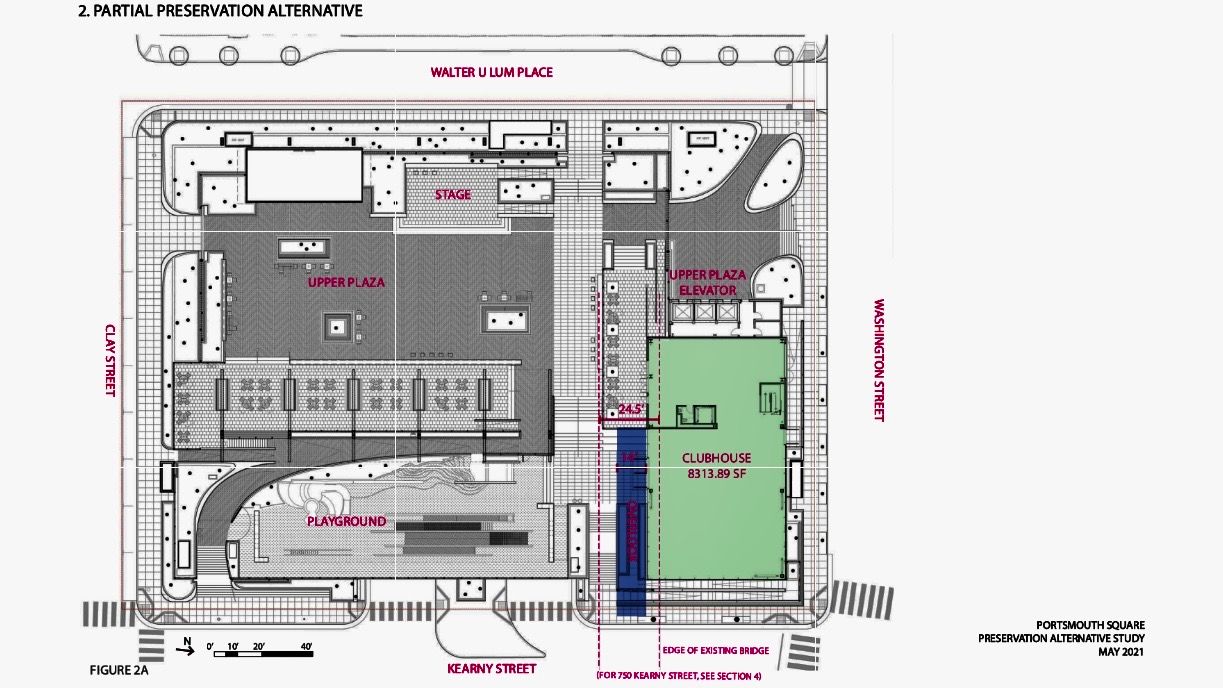
The renovation includes removing the pedestrian bridge that connects the park and Hilton Hotel over Kearny Street to make room for a two-story, 29-foot-tall, 8,300-square-foot clubhouse, which will replace the existing smaller one.
For over 50 years, the Portsmouth Square/Kearny Street pedestrian bridge has been San Francisco Chinatown's iconic structure: a symbol of the fight for inclusion and equal opportunity, a spot for large gatherings and group photos, a sign of connection between the Financial District and Chinatown, and good Feng Shui to bring in fortune and luck.
Focus of opposition from larger community members: the removal of a historic pedestrian bridge built by Chinatown community
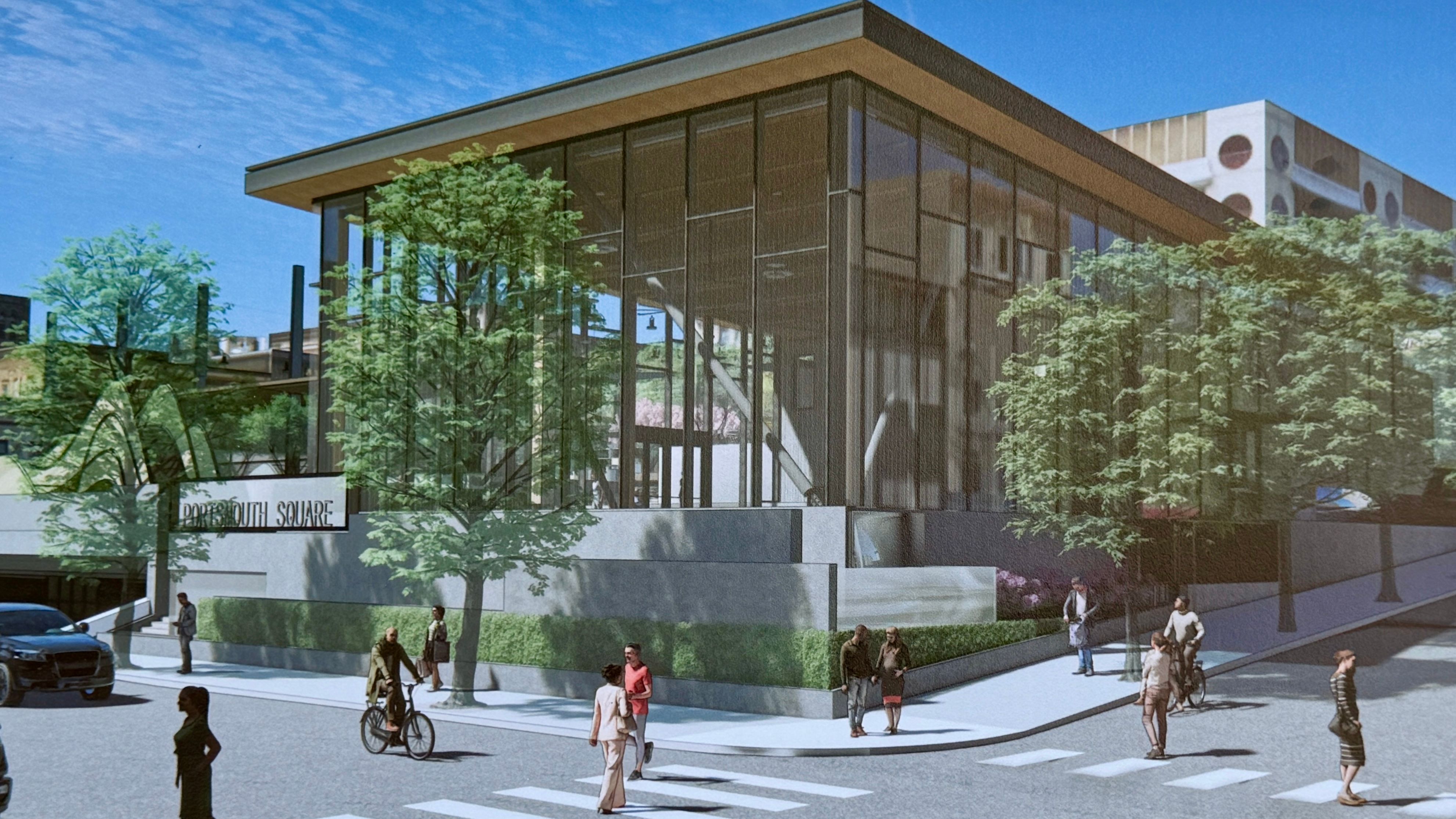
The demolition of the pedestrian bridge to exchange for a much bigger clubhouse has been the focus of opposition from a larger Chinese community than the four non-profit organizations—Chinatown Community Development Center (CCDC), Self-Help for the Elderly, Community Youth Center (CYC), and Chinese Culture Center of San Francisco (CCC)—which have supported the demolition and been invited by the city to all discussions relevant to the Portsmouth Square renovation project from Day one.
The 176-year-old prestigious Chinese Consolidated Benevolent Association (CCBA), which represents the family association community in Chinatown, was never invited to project related community meetings.
"The non-profit groups in Chinatown do not represent all of us, they only represent their own interests," said 94-year-old Albert Chang, owner of the Chinatown Kite Shop since 1972.
Chang said he has been at his store in Chinatown every day and no one from the city has ever asked his opinion on the project. "It was factually incorrect when the city repeatedly cited that 77% of survey participants supported removing the bridge. I was never told about any such survey."
Supporters of the bridge demolition described the Portsmouth Square pedestrian bridge as "a bridge that goes nowhere."
Chang disagreed and said, "This bridge is where I go in Chinatown every day to take a break, walk around, and enjoy the sun. A park should be a warm, green, open environment for people to relax, not for indoor meetings. Why does the Portsmouth Square need a larger clubhouse for the non-profits?"
Opponents from the Chinese community, including architect Sam Kwong, believed the City failed to follow the rules by not providing alternative plans for considerations in trying to keep the historic bridge.
Kwong, whose architecture firm is located in Chinatown for decades, spoke against removing the Kearny Street pedestrian bridge during an April 2022 Board of Supervisors meeting. All board members, including two Chinese American Supervisors Connie Chan and Gordon Mar, voted unanimously to revoke the permit for retaining the Portsmouth Square pedestrian bridge.
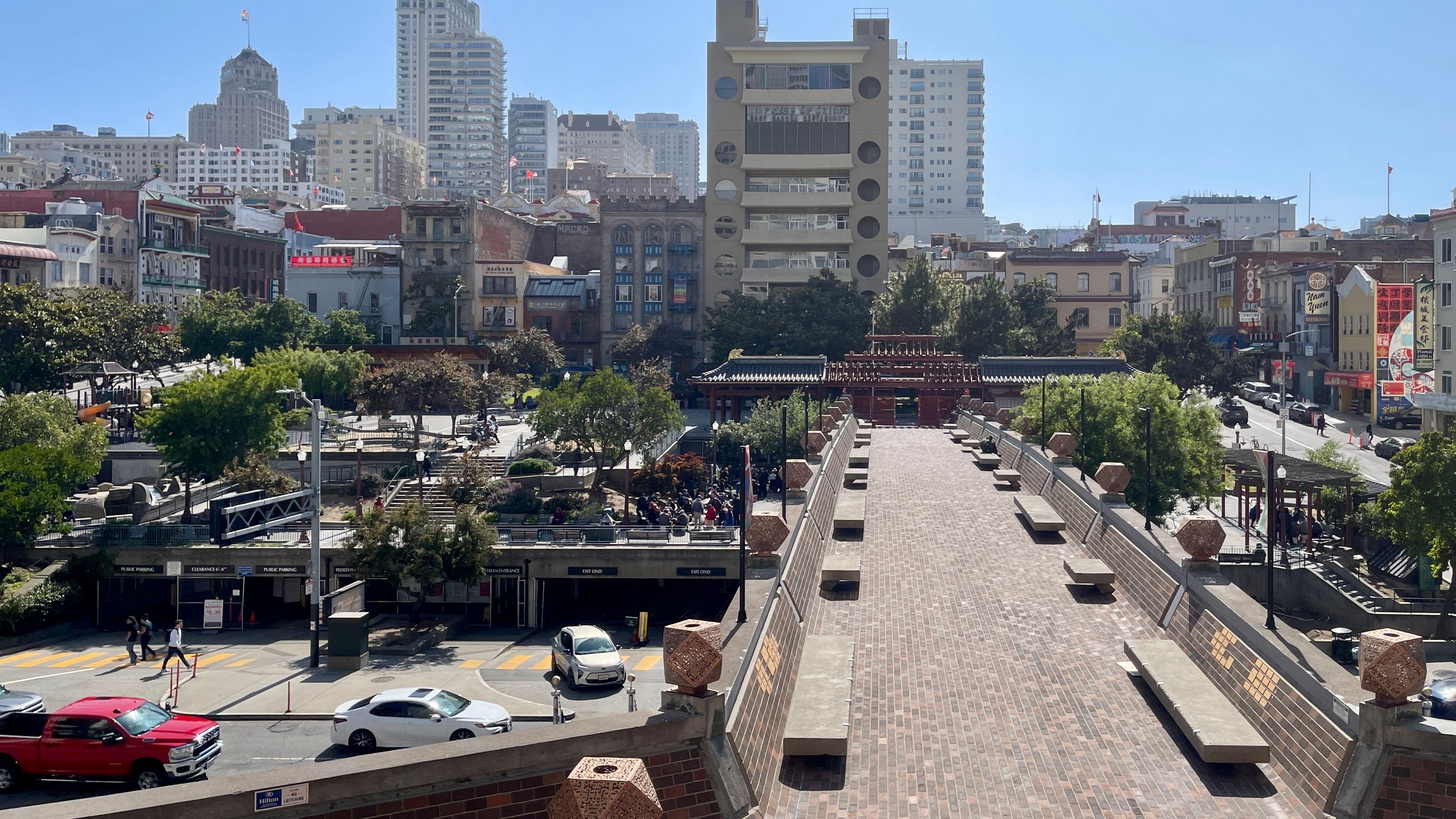
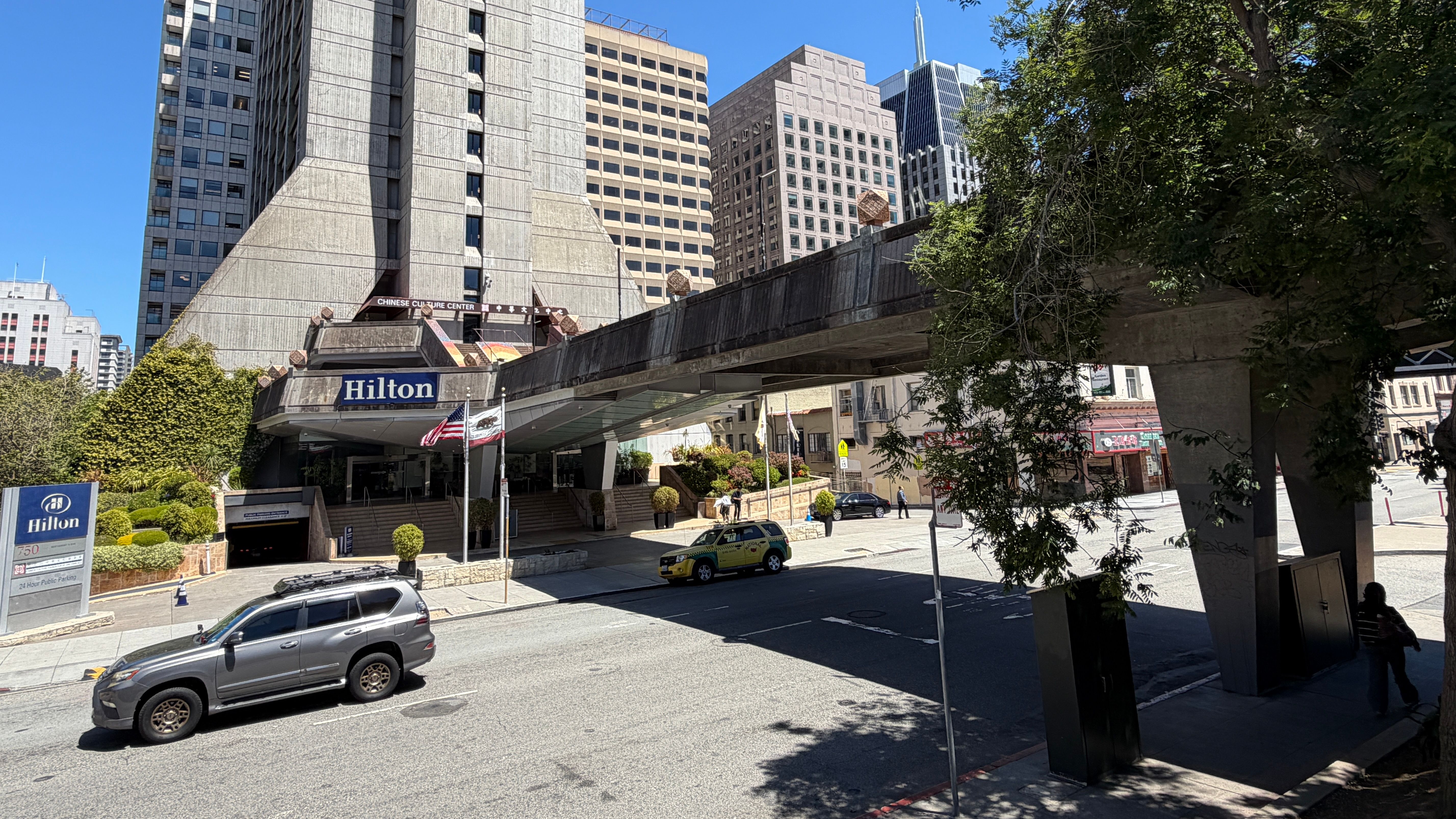
Kwong said the 28-foot-wide and 240-foot-long pedestrian bridge has been architecturally unique in shape and design and very valuable to Chinese American history. It is the only pedestrian bridge of its kind in the San Francisco Bay Area.
"The City ignoring the voice of a larger Chinese community outside the scope of the non-profit organizations is no different from [President] Trump's administration," Kwong said with disappointment and sadness. "The City is erasing the history of our community and the contributions of Master Architects Clement Chen and Chen Chi-Kwan, and other leaders who raised funds to build the good feng-shui pedestrian bridge with the goal of connecting Chinatown with the Financial District to bring in fortune and luck."
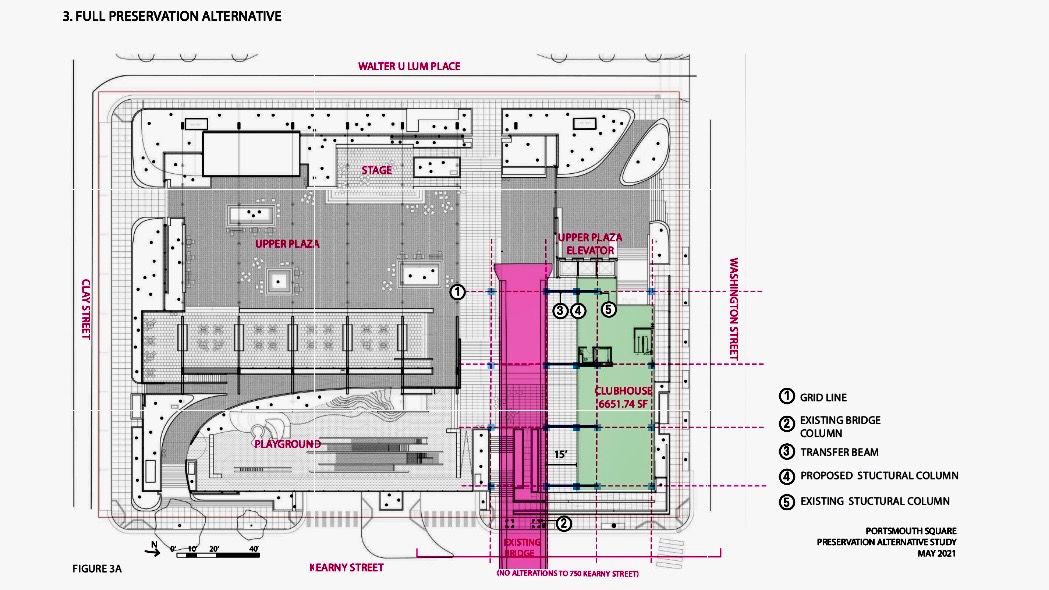
Documents show that after the details of the renovation project were presented, the San Francisco Planning Department conducted a study in 2021 and released a 455-page report, titled Memo to the Historic Preservation Commission, in 2022 with recommendations, including Full Preservation Alternative and Partial Preservation Alternative, for preserving the Kearny Street pedestrian bridge’s historical and cultural significance to the Chinese community.
The report also cited that the removal of the bridge "would cause a significant and unavoidable impact to identified historic resources."
Portsmouth Square Park was established in 1835. "By the 1870’s, residents of Chinese descent were firmly established around the Portsmouth Square area and the park was an important space within the community, known locally as Square Fa Yuhn Gok, or the garden corner," the report noted.
750 Kearny Street, where the existing Hilton Hotel (formerly the Holiday Inn) has been located since 1851, is one of the city's earliest developed sites. In 1852, San Francisco purchased the site and repurposed it to accommodate a new City Hall and later the Hall of Justice. In 1960, the City relocated the Hall of Justice and transferred control of the property to the City's Redevelopment Agency.
San Francisco Greater Chinatown Community Service Association, a Chinatown-based community and civil rights group in the 1970s, lobbied the Board of Supervisors to consider repurposing the former Hall of Justice as a Chinatown community center and museum. The City decided to sell the site to a developer for the construction of the Holiday Inn Hotel, which included a community-backed cultural center: the Chinese Cultural Center.
Chinese American architect Clement Chen and his associates designed the Holiday Inn Hotel and the Chinese Culture Center (which opened on the hotel's third floor).
The elevated pedestrian bridge connecting the cultural center in Holiday Inn Hotel and Portsmouth Square was designed by Taiwanese architect Chen Chi-Kwan and American landscape architect Robert Royston. The bridge and the hotel both opened in 1971.
The Planning Department concurred in the 2021 report that the Kearny Street Pedestrian Bridge was significant for "its association with the growing political power of Chinese American residents of Chinatown and San Francisco," "as a unique and representative example of the Brutalist Style and of a rare construction type: the pedestrian bridge," and "with Master Architects Clement Chen and Chen Chi-Kwan."
Because the proposed project was anticipated to significantly and unavoidably impact a historic resource through demolition, the report stated that the project "should avoid or substantially lessen any significant effects while still meeting most of the basic objectives listed above."
"Under the Full Preservation Alternative, the park would be renovated in a manner that retained the Kearny Street Pedestrian Bridge while setting back the south wall of the proposed clubhouse by 15’ and reducing the footprint of the proposed clubhouse from 8,313 square feet to 6,651 square feet," the report recommended. "The proposed 15’ setback would provide adequate space between the bridge and clubhouse to take advantage of natural light provided by the glazed southern wall of the clubhouse while also conforming to fire and safety codes."
In conclusion, the Planning Department found that "the Full Preservation Alternative would maintain a majority of the character-defining features of the pedestrian bridge and therefore, would result in a less-than-significant impact on the historical resource."
Lisa Ye: Remembers early days spending time on the pedestrian bridge as a resident in Chinatown
Lisa Ye is a small business owner and resides in the Oceanview neighborhood in San Francisco. She found no reasons for the city to take down the Portsmouth Square pedestrian bridge for the sole reason of building a larger club house for the non-profit groups.
Ye was born in Guangzhou, China, and immigrated to San Francisco with her parents and siblings at the age of 13 in 1980. She and her family lived in a small apartment in Chinatown as their first home in the country after they landed in San Francisco over four decades ago.
"Restaurants and shops in Chinatown opened until very late at night at 11pm, midnight and even 1 or 2 am in the morning," Ye recalled. "As a teenager in those days, we hung around the pedestrian bridge during the nights because our apartment was so small."
"The pedestrian bridge reminds me of my journey as a new immigrant at those days. It has accumulated many rich and profound immigrant stories for many Chinese Americans like mine," said Ye. "We are grateful for the effort and courage of our community leaders in the 1970s to raise funds to build the bridge. Up to the present time, I couldn't understand why the City would make a decision to take down the bridge. The bridge is our history and treasure."
When supporters of the demolition called the bridge "goes nowhere," Ye said it was about management and maintenance of the bridge by the City, not about the bridge itself. "It would be a beautiful bridge if the bridge was well-maintained and re-decorated by the City."
A group of Chinese American housekeepers working at the Hilton Hotel were informed that the hotel would close for two weeks during the demolition.
"All workers at the Hilton Hotel wanted to keep the bridge. It is not about losing our wages, but about the landmark, history, legacy, and Feng Shui behind it," said Fan Chen, one of the housekeepers.
Howard Wong, a retired architect and former city architect at the Bureau of Architecture specialized in designing projects for the Recreation and Park Department, was one of the very few community members interviewed by Wind Newspaper in support of the removal of the pedestrian bridge.
Wong said he had spoken at public meetings for years to support the removal of the bridge based on his architectural perspective. He believed that a pedestrian bridge should not be elevated over a major street. However, he was not satisfied with the design of the approved project to renovate Portsmouth Square park.
Wong said the design lacked cultural elements to highlight the Chinatown community where Portsmouth Square Park is located. In China, modern Chinese architecture often reflects its Chinese cultural background. "I hope it will look more Asian."
Ed Siu: Waste of manpower and resources to remove the bridge; the City hurts Chinatown deeply by starting three major renovation projects at the same time during summer
Ed Siu, Founder and President of the Merchants United Association of San Francisco with over 150 merchant members from Chinatown, Sunset and Ocean Avenue corridor, joined other merchants to protest against the removal of the pedestrian bridge and the schedules of three major renovation projects in Chinatown to begin in June.
"First, taking down the pedestrian bridge is a waste of manpower and resources," said Siu. "The City now is facing a huge deficit. Why does the City still want to spend millions of dollars to remove a bridge that holds profound history for the Chinese community and to destroy a bridge built with blood and sweat? It didn't make sense at all. I wonder what were the intentions behind it?"
Siu said taking down the bridge which the City did not build, was totally disrespectful to the community leaders of the late 1960s to early 1970s who fought for representation and connected Chinatown with the Financial District to bring in fortune and peace.
"Second, it was also about Feng Shui. Did they want to cut off the link between the Financial District and Chinatown?" said Siu. "The City keeps reminding us the project was supported by 77% of survey participants. Who were the participants in the survey? Did the survey cover a large sample and diverse backgrounds of community members?"
"Third, it was not true that 'the bridge goes nowhere.’ Many Chinese organizations still go to the bridge for group photos during special events, gatherings, and festivals," Siu added.
Wind Newspaper received increasing complaints from Chinatown merchants that starting construction simultaneously on the three major renovation projects in Chinatown would significantly impact Chinatown businesses.
Some restaurant and cafe owners in Chinatown estimated they would lose 30%-50% of their regular business during during construction.
Siu questioned whether city agencies—the San Francisco Mayor's Office, Department of Public Works, Recreation and Park Department, Department of Public Health, and Public Library—had coordinated to minimize the impacts on the Chinatown community, affecting both merchants and residents.
Siu said the economic downturn during the pandemic hurt Chinatown businesses badly. Chinatown has slightly recovered in recent years. "Summer is always the peak season for all businesses in Chinatown. Why did the City want to start construction in June? It will impact all of us deeply."
"I was also a victim of the Central Subway's 10-year construction," said Siu whose travel agency was located on Stockton Street, one block from the Chinatown Rose Pak Station entrance. Noise, traffic, and dust hurt Siu's and other merchants' businesses for over a decade, driving their customers away.
Seniors, skateboarders and tourists like to see the pedestrian bridge stay
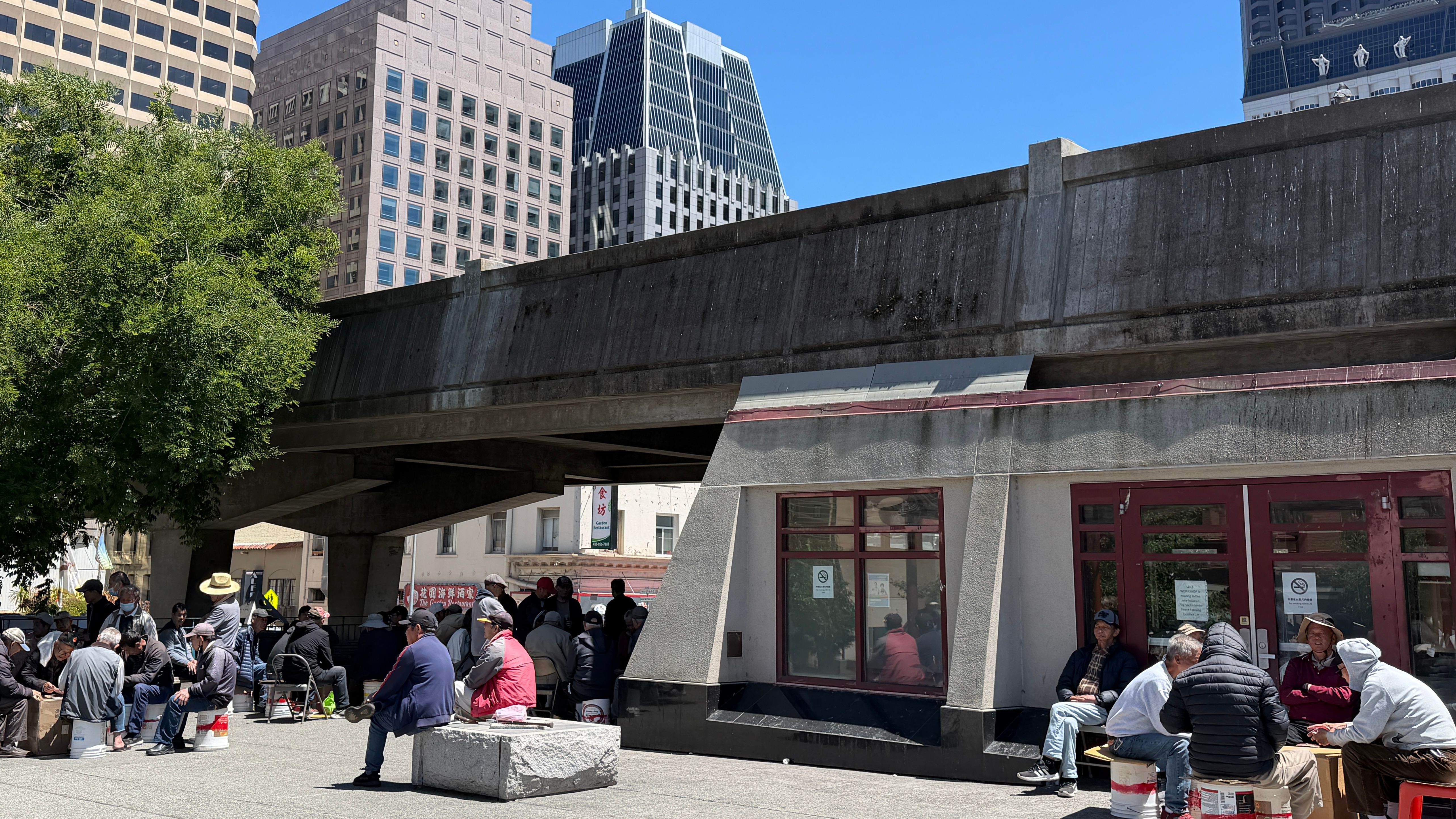
Hundreds of seniors stay in Portsmouth Square to play cards and chess every day. 75-year-old Chu Zhou was one of them who spoke to Wind Newspaper against the renovation plan. Zhou lives in a senior housing facility in the Bayview and takes the Central Subway to Chinatown every day.
Zhou said she and her friends had no plan yet where to go after Portsmouth Square Park closed for construction. She disliked seeing the bridge torn down to build a much bigger and taller clubhouse in the park.
"The existing club house is always closed and opened only for events by the nonprofits or city agencies. Same as the clubhouse at the Willie Woo Woo Wong Playground," said Zhou. "We like to play cards outdoors with more fresh air and sun. The City is building a bigger clubhouse in Portsmouth Square to take away more open space from us."
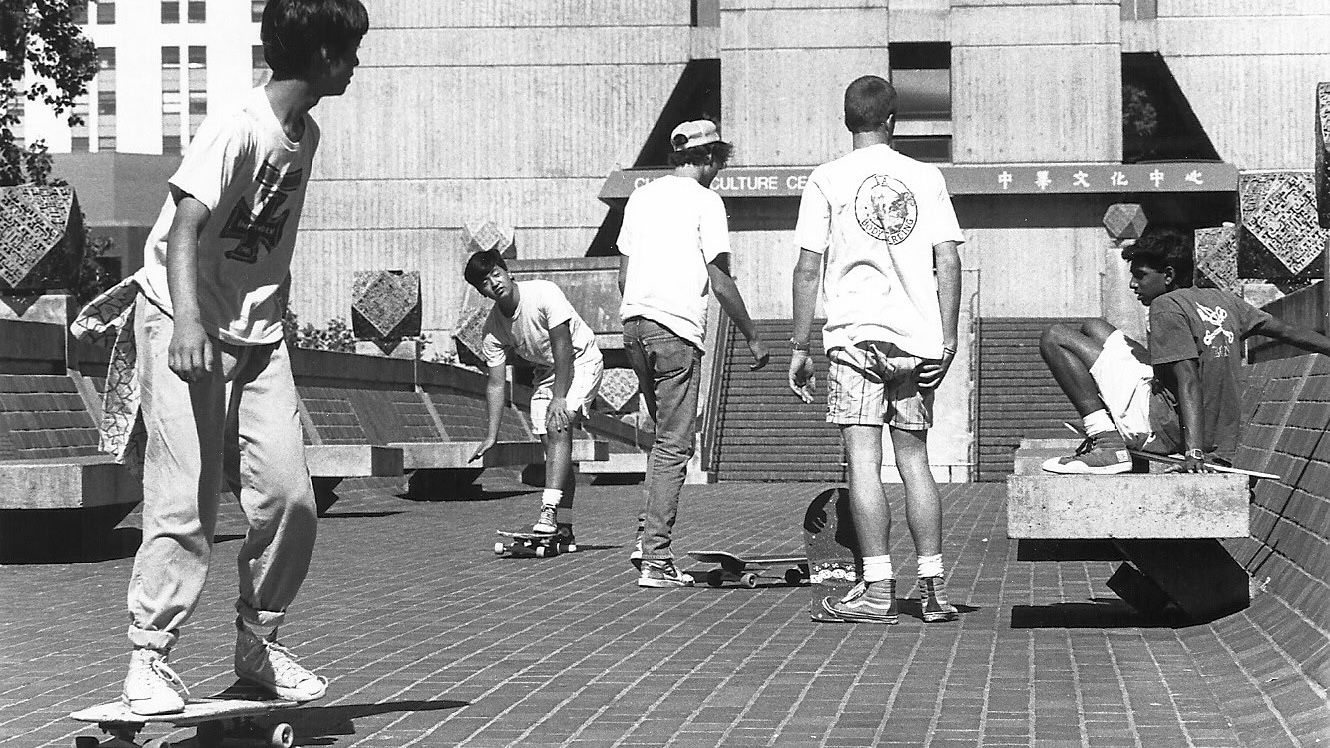
In the final hours before Portsmouth Square closed to the public, college students Elijah Quincy and Jason Gomez from San Jose came over to skateboard on the pedestrian bridge. They hadn't followed the news for construction updates, but they learned about the pedestrian bridge's history; it was recognized nationwide as a local skate spot in the 1990s.
"The bridge has been a symbol and part of the history of San Francisco's Chinatown and Chinese culture. It has served well, extending to all communities and ethnicities including us skateboarders," said Gomez. "It is sad to hear that the bridge will be gone soon. The City should keep the bridge."
Cade Brasher, a tourist from Minnesota, stayed at a hotel two blocks east of Portsmouth Square. He enjoyed walking on the 240-foot pedestrian bridge and learned from Wind Newspaper that it would soon be demolished. "Please tell the City of San Francisco that I like the bridge and want to keep it."
It was the first time for Edgar Guerra and Lizeth Jimenez of Mexico traveling to Chinatown and walking on the pedestrian bridge. They also learned from Wind Newspaper that the bridge was in its final days before the demolition.
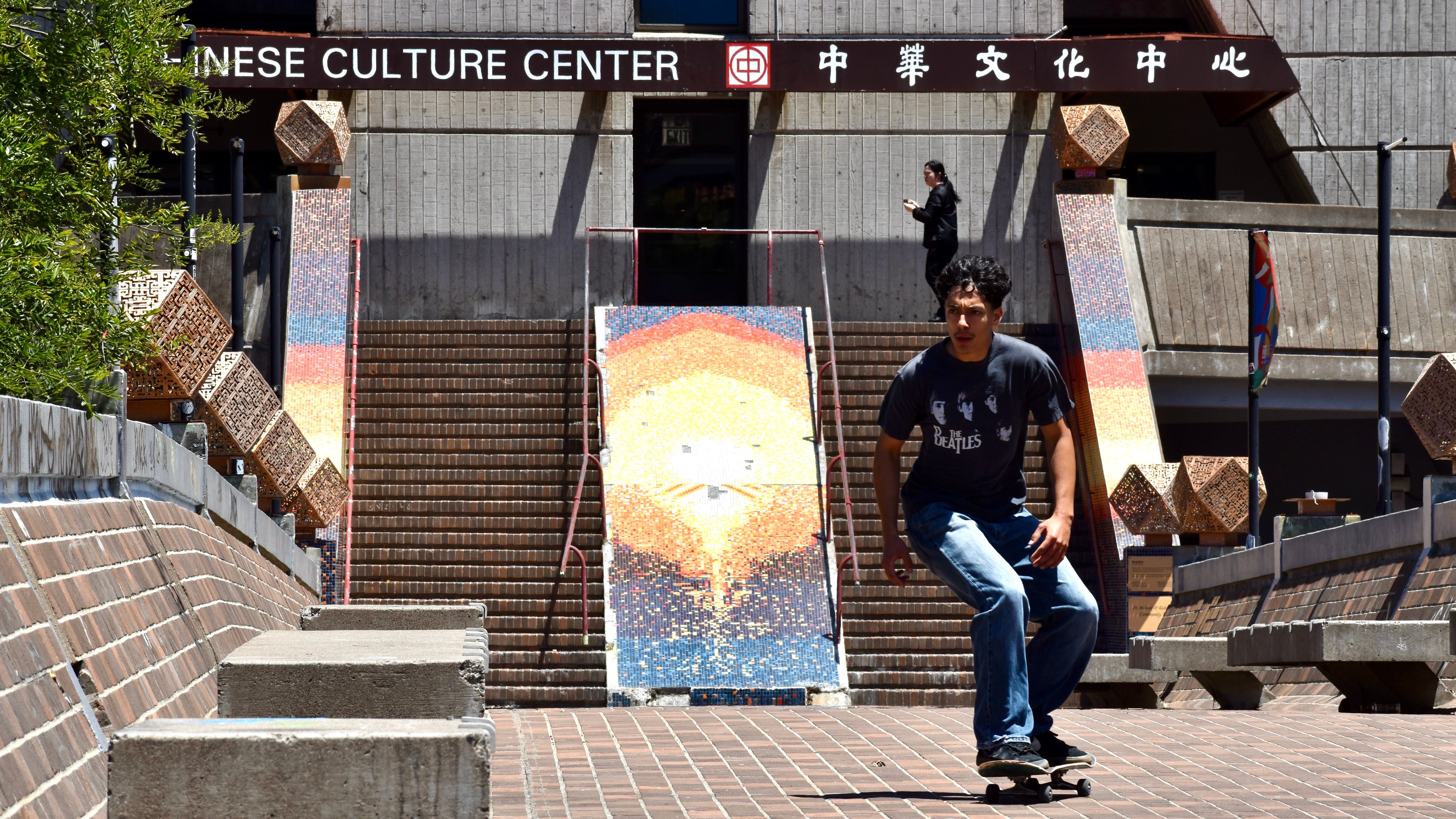
Guerra and Jimenez were shocked to hear the plan to remove the bridge. "This bridge is a good spot for residents and tourists like us to rest under the sun. The bridge has a very unique design and shape for a metropolitan city. This bridge represents the Chinese community's rich history. Why would the City think about eliminating it? For a bigger clubhouse over the history? We can't understand."
Self-Help for the Elderly: "Our seniors have been waiting for a long time for a modernized, functional Portsmouth Square Park and Community Center."
Leaders of two non-profit organizations commented on the City’s press releases related to the ground breaking ceremony of the Portsmouth Square renovation project.
“In the densest residential community in San Francisco, where 60% of our housing are SRO’s, Portsmouth Square is a literal and figurative community living room. That’s why this community has engaged and advocated for this reimagining of our living room for over 15 years,” said Malcolm Yeung, CEO of Chinatown Community Development Center (CCDC).
“I am grateful to the thousands of Chinatown residents and stakeholders for engaging, for struggling (sometimes with each other), and for advocating to make this reimagination a reality. And I want to thank the Rec and Park and all of our city agencies for partnering with us along the way,” Yeung commented.
“Our seniors have been waiting for a long time for a modernized, functional Portsmouth Square Park and Community Center,” said Anni Chung, Self-Help for the Elderly Executive Director. “Today’s groundbreaking ceremony fills our hearts with joy, telling us the new park will be ready soon. We look forward to working closely with the Rec and Park staff to transform Portsmouth Square into the most visited and beautiful park that our community deserves.”
City agencies: A survey found overwhelming support for the removal of the bridge; City agencies have closely coordinated on the delivery of three capital improvement projects to minimize construction impacts
Wind Newspaper sent inquiries to Mayor Lurie's office, the City's Department of Public Works, Recreation and Park Department, Department of Public Health, and Public Library regarding all three renovation projects in Chinatown. City agencies responded with a joint statement.
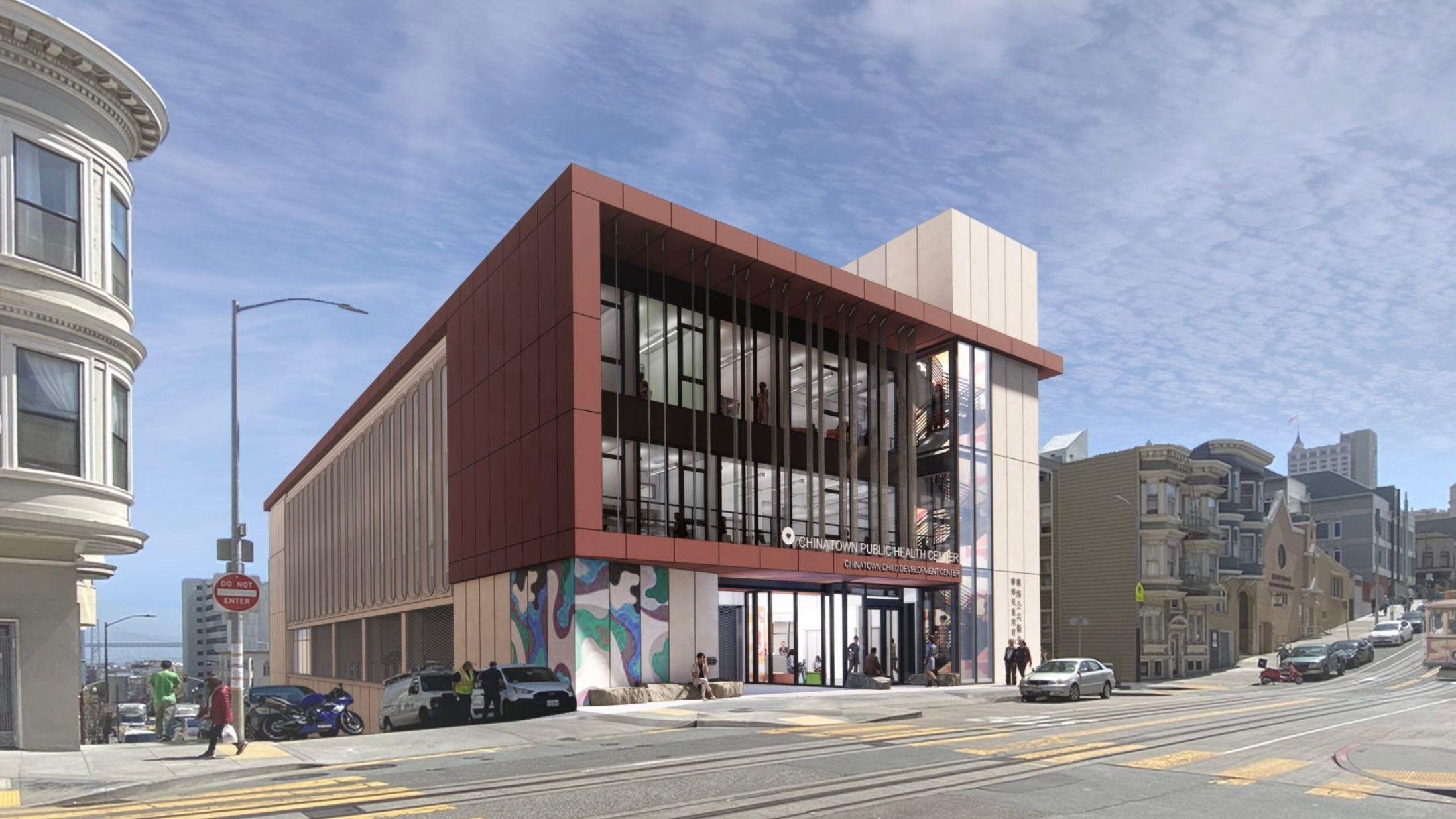
"The City is investing a combined $156.5 million in these three capital projects to improve neighborhood- based health care, library services and the recreation experience in Chinatown," the City wrote. "While construction by its nature causes impacts, the City is taking great care to reduce disruptions, for example, around cultural events and the start of the new school year."
The Department of Public Works is managing construction on each of those three projects in Chinatown. "The City took the unprecedented action of bringing aboard a construction coordinator to ensure strategic and transparent project coordination. Cristina Olea, a seasoned project manager at San Francisco Public Works, is serving in the role of project coordinator for the three Chinatown projects."
The City responded that outreach efforts were made to inform the community of the construction plans for three projects including an open house on June 2 at the Portsmouth Square clubhouse; an upcoming open house celebration hosted by the Public Library on June 13 about the Chinatown branch renovation project; press conference held on May 27 to announce moving Chinatown Public Health Center services to Chinese Hospital temporarily from June 22.
“The bridge was one of the most discussed elements of the Portsmouth Square project and a survey found overwhelming support, with more than three in four respondents supporting removal of the bridge," the City agencies wrote about the removal decision.
"Removing the bridge creates space for a new community clubhouse, ADA-accessible ramps from Kearny Street and a more open park design with improved visibility, accessibility and connections between Portsmouth Square and the surrounding neighborhood."
"The City recognizes that some community members disagree with that decision, but the project reflects years of public input and review through the City's planning and approval processes."
City agencies denied that the process to determine the bridge’s fate failed to follow city rules. "The City has abided by all applicable state and local law in planning the entirety of the Portsmouth Square project."
- Prop G gets a second chance for San Francisco voters to decide the fate of the Upper Great Highway in the November election
- 23 parking spaces during commute hours added in Chinatown amid 3 major renovation projects
- Asian supermarkets are booming in the San Francisco Bay Area with intense industry competition
- Architect Dartmond Cherk: Taking away this symbolic bridge would deflate the standing of the Chinese community in San Francisco
- Our Mission and Policy
- San Francisco: Kearny Street, between Clay and Washington streets, to be fully closed Aug. 1-2 and Aug. 8-9; Broadway Tunnel closed Aug. 15-16
- Carla Lee Hurley and Kirk Yin, 2 bilingual and community-oriented police officers, promoted to Captains in SFPD
- Over 15,000 signatures submitted, San Francisco citywide voters might have a chance to reopen Upper Great Highway