Proposition B authored by Supervisor Chen to create a Public Bank in San Francisco faces mounting opposition

SAN FRANCISCO — Proposition B, a city ballot measure asking San Francisco voters to support amending the City Charter to create a municipal finance corporation and a non-profit public bank to provide loans, has faced much opposition including from the Asian community.
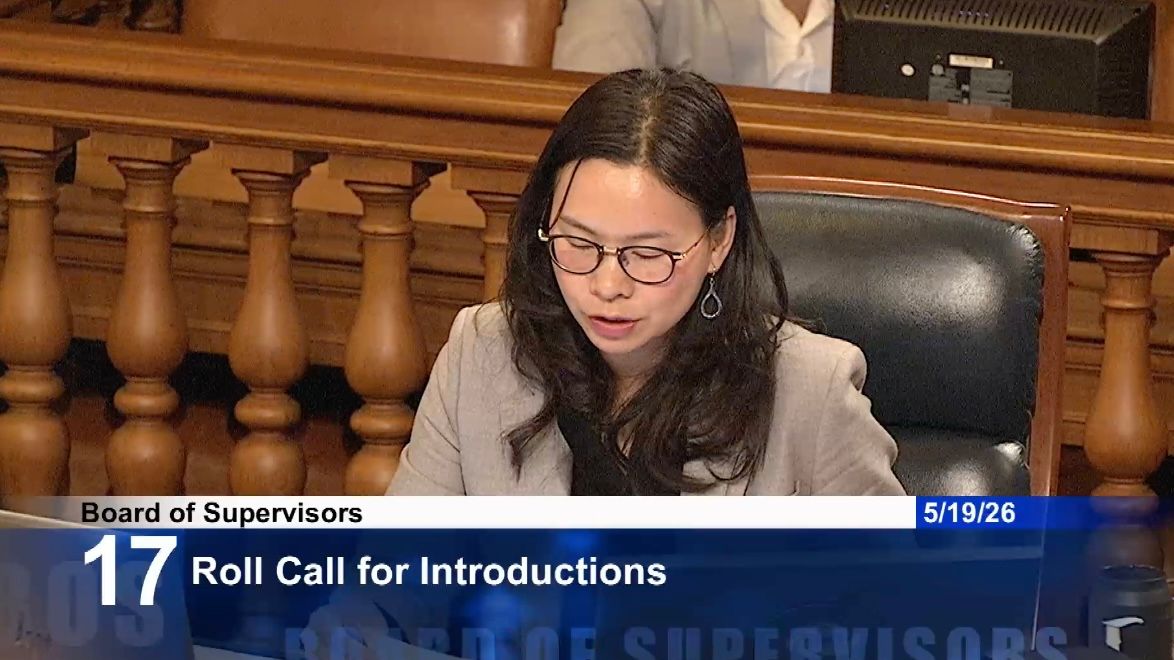
Prop B was authored by District 11 Supervisor Chyanne Chen who introduced it on May 19 at the Board of Supervisors meeting. The board voted 9-2 on July 7 to approve placing the measure on the November 3 election ballot. District 2 Supervisor Stephen Sherrill and District 4 Supervisor Alan Wong voted against the Charter amendment measure.
Under Prop B, the measure will amend the San Francisco Charter to create a municipal finance corporation and a public bank that would exist as nonprofit corporations, each overseen by an oversight commission and a board of directors.
"Prop B will ensure that a San Francisco Public Bank is fiscally responsible, independent from political influence, and serves San Francisco's priorities," Chen wrote in the ballot argument filed with the Department of Elections.
"A Public Bank puts the people of San Francisco over private profits to finance the things we need. The shareholders would be the people of San Francisco, so we benefit not only from our bank's profits but also from the San Francisco projects it supports," Chen said in the filing.
Chen said the future San Francisco's Public Bank would provide affordable loans for affordable housing development and ownership, small business development, environmental sustainability, and justice.
"Prop B is not a tax and will not raise taxes for San Franciscans," Chen wrote.
Saikat Chakrabarti, former candidate in June running for Congress representing San Francisco, supports Prop B. "We have the chance to create the first municipal bank in the country to serve small businesses, build new housing, and support climate initiatives. Vote yes on Prop B on November 3rd!” Chakrabarti said.
Mayor Daniel Lurie joined the opposition against Prop B and argued that "creating a new institution, rather than investing those resources directly in housing, small businesses and other critical needs, is irresponsible."
"Would I like more tools to fund affordable housing and climate infrastructure? Sure. Am I convinced City Hall is ready to run a bank? No. We already have tools for these problems. Let’s use them," Sherrill said in a statement opposing Prop B.
Wong attended a press conference hosted by the No on B campaign earlier and made remarks why he disagreed with Prop B and voted against the idea of starting a public bank at the Board of Supervisors meeting.
"A public bank may promise to advance goals we all care about. But before we put the government in the banking business, we have to ask a few basic questions. Is the government the right institution for the job? Are we equipped to do it well? Is it even necessary? And who bears the risk when things go wrong?”
“Right now San Francisco is facing a significant budget deficit. We are making difficult choices about the service we can afford and where public dollars can do the most good," Wong said.
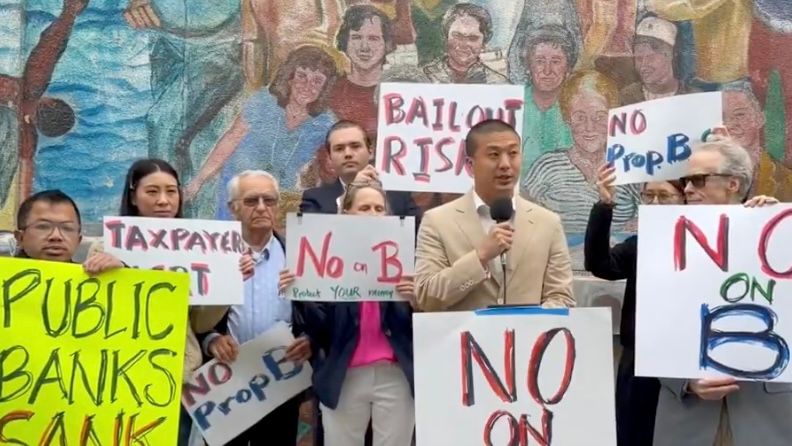
"There is no shortage of important work for San Francisco to do. At a time when our resources and capacity are already stretched thin, we should be very careful about taking on entirely new responsibilities, especially one that carries significant financial risk, because banking is fundamentally a business of managing risk," Wong stated.
"A public bank would put San Francisco in an entirely new and specialized business. It would require significant public capital and expose the city to the financial and operational risk of running a bank. In a private bank, shareholders bear the risk. When investments go bad in a public bank that risk ultimately falls onto taxpayers. That does not mean that the government should never take on risk but when public dollars are at stake we have an obligation to know what we are getting into."
"We should also ask whether creating an entirely new public institution is necessary in the first place. San Francisco already has community lenders, credit unions, nonprofit loan funds and other financial partners doing this work," Wong added. "They are already lending to small businesses, affordable housing developers and communities that historically struggle to access capital. If we can advance these same goals by strengthening institutions that already exist, we should ask why creating an entirely new city bureaucracy is a better answer."
Chinese American Democratic Club (CADC) opposes Prop B. "Prop B allows San Francisco to establish a nonprofit Municipal Finance Corporation that could finance affordable housing, small businesses and other public priorities and potentially evolve into a city-owned public bank," CADC wrote in its rationale.
"CADC opposes Prop B because the measure creates the institutional framework without identifying a secure source for the substantial capitalization needed to establish the bank. Members were concerned about financial risk and committing the City to a banking structure before its funding and long-term viability were clear."
Leslie Huang filed her opposition to Prop B with the Department of Elections. "Prop B asks San Francisco voters to create a City-Hall controlled public bank and municipal finance corporation-without any dedicated funding, without proven demand, and at a time when the City already faces massive shortfalls."
"Supporters claim this will unlock affordable housing and small business lending. In reality, it creates a new politically appointed entity with the power to take significant financial risks using public resources," Leslie wrote in the filing. "The City's own working group previously estimated that hundreds of millions of dollars would be needed to capitalize such an institution. Prop B provides none of that capital. It simply builds the structure and leaves taxpayers holding the bag later."
Small business owner Tuan Ngo joined the No on B campaign and made comments publicly against Prop B. “This is extremely misleading. When people hear about public banks, they think of a regular bank where you can put your money in deposit. That’s not it. This is not a public bank for the public. This is where they channel money to special interests and the Board of Supervisors get to appoint their own puppets to control this bank and it’s all at taxpayer risk and expense. Be aware! Vote NO on Prop B.”
"There is no checking account in this measure. There is no consumer branch. There is a City Hall lending vehicle, written into the Charter, with no funding plan and up to $460 million in risk," the No on B campaign stated.
- Chinese community members say Prop H unfairly makes property owners pay for the San Francisco public transit agency’s shortfalls
- Opinion: City College opened doors for my family. Let’s keep them open.
- Opinion: Share the Great Highway. Keep San Francisco inclusive. Yes on G.
- A pre-election national AAPI poll: More AAPI adults trust Democrats over Republicans in handling issues
- Voters in 5 counties of the San Francisco Bay Area to decide whether to raise the sales tax by 0.5% or 1% for 14 years to fund public transit
- Opinion: A voice for every community and the next generation of San Francisco
- Opinion: Let’s vote yes on 5-county Bay Area regional measure and San Francisco Prop H for clean, safe, and reliable public transit!
- California leads in dedicating September 25 as annual Dolly Parton Day in honor of the American icon’s legacy of love