Architect Dartmond Cherk: Taking away this symbolic bridge would deflate the standing of the Chinese community in San Francisco

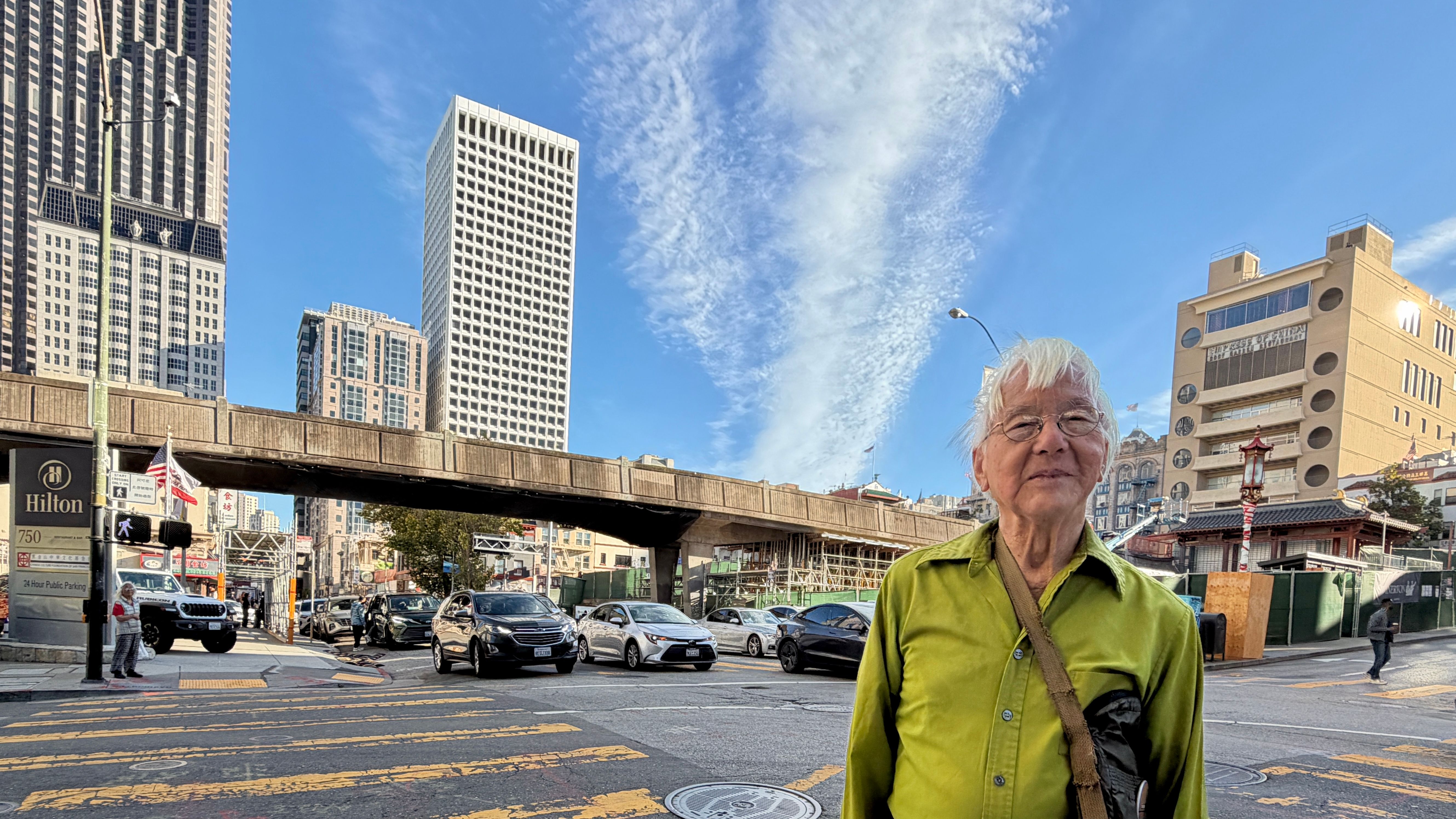
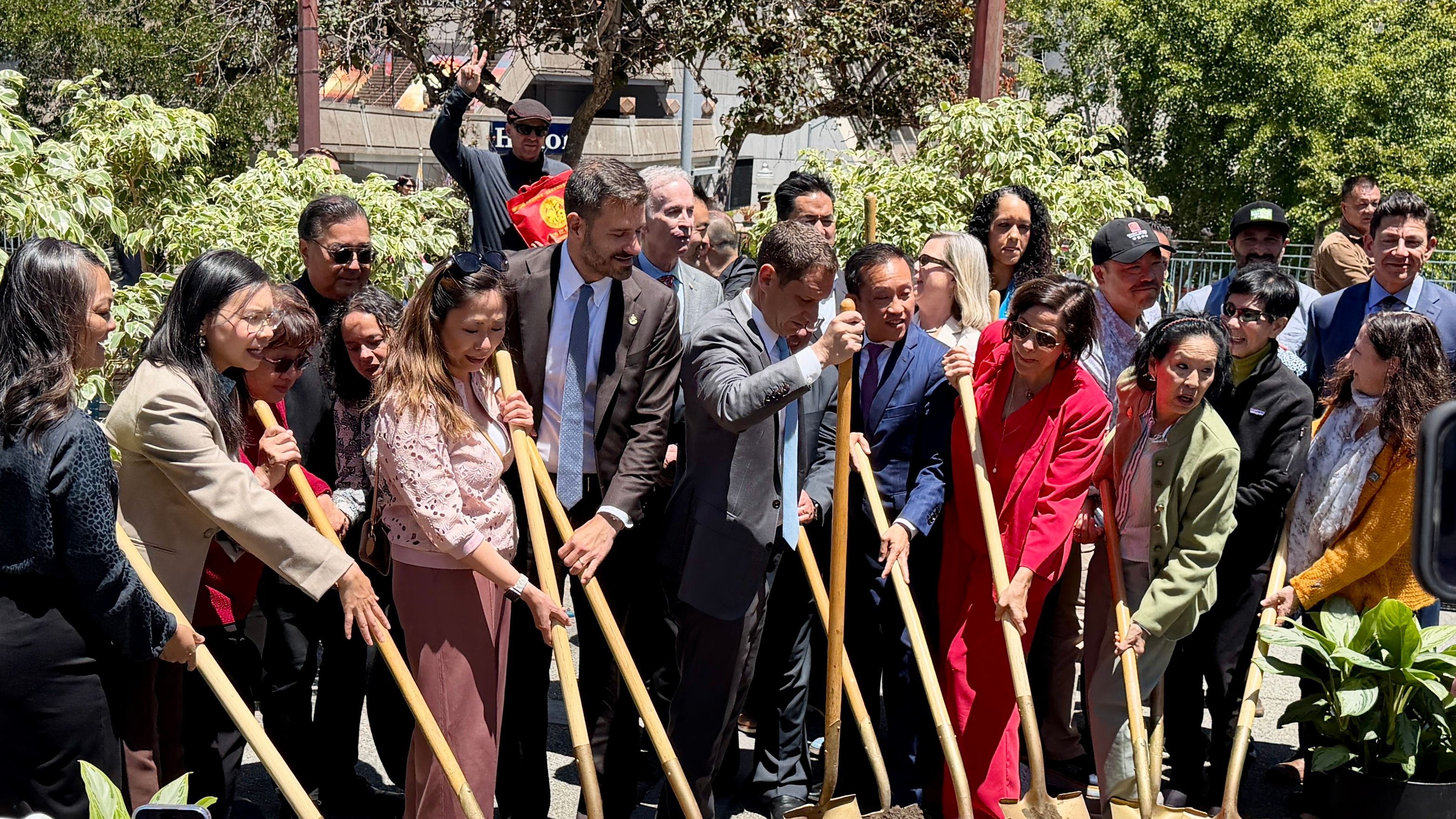
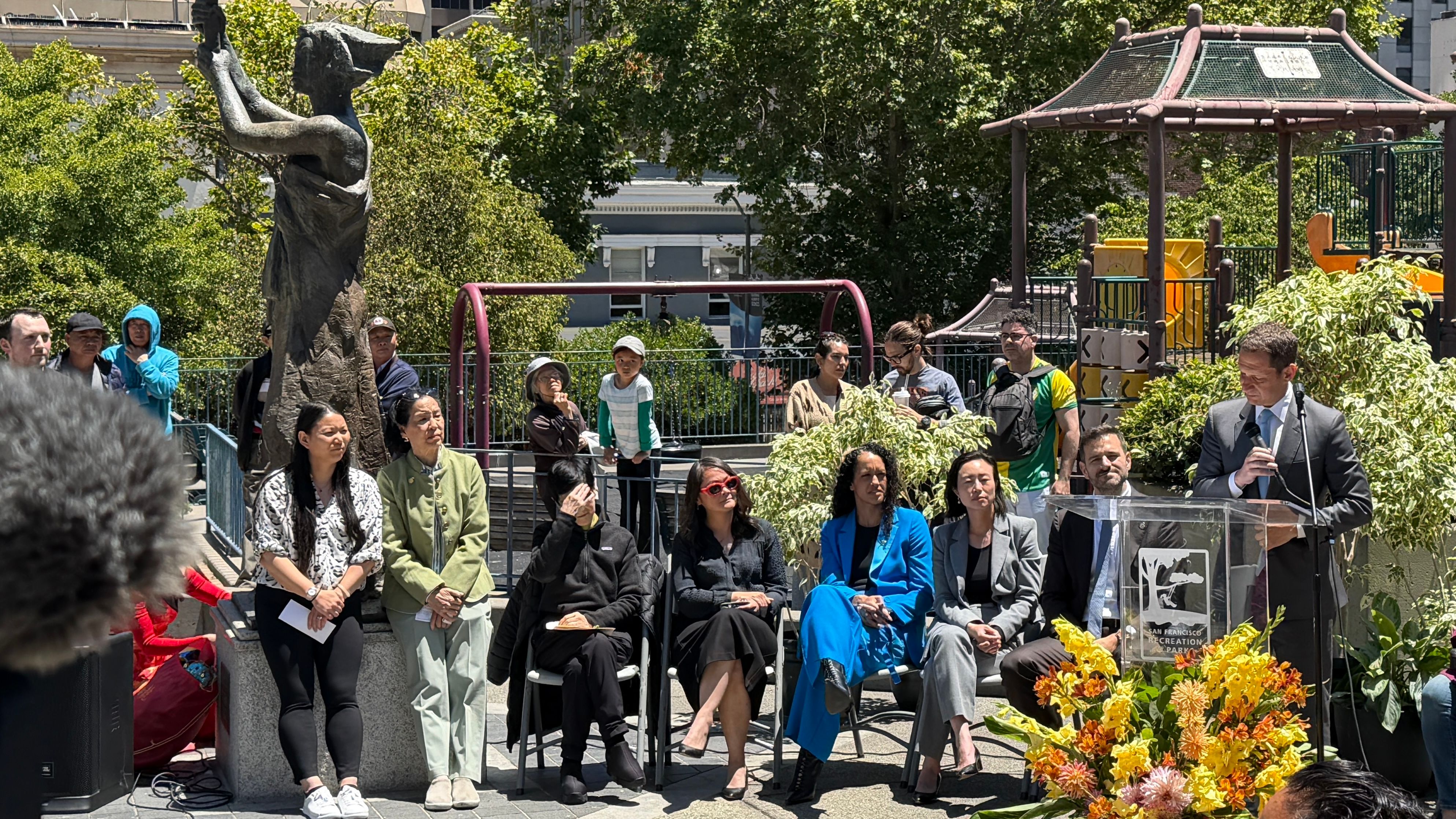
SAN FRANCISCO — After Mayor Daniel Lurie and city officials gathered on June 9 for a groundbreaking ceremony to kick off the $73 million two-year renovation of Portsmouth Square park and the removal of the pedestrian bridge spanning Kearny Street, opposition to demolishing the 56-year-old pedestrian bridge has grown louder. One of those voices belongs to 93-year-old Dartmond Cherk, a Chinese American architect who designed both the hotel and the bridge in 1965.
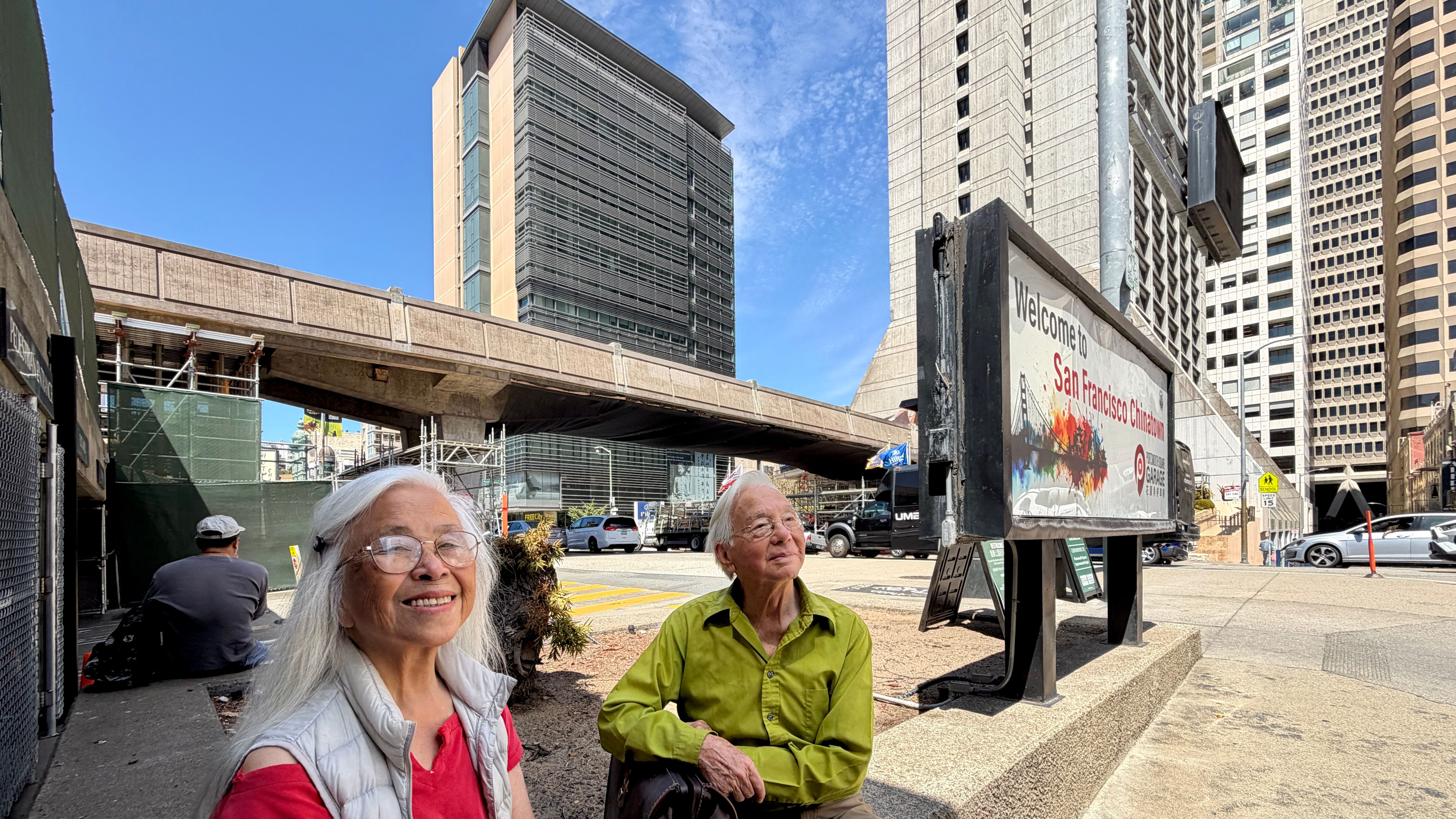
"It was wrong for the City to destroy the history of Chinatown by tearing down the bridge," Cherk said with disappointment and sadness when he visited the bridge with his wife Esther Lee Cherk in the surrounding area on the ground of Kearny Street on July 25. Part of the structure of the bridge connected to the Hilton Hotel was already broken by construction workers.
The entire park and the bridge were closed off to the public from June 9 after the groundbreaking ceremony ended. Cherk and Lee were unable to look closer at the bridge that Cherk designed over six decades ago.
Cherk only found out the demolition of the Portsmouth Square pedestrian bridge to begin soon by reading the recent news article published in the Wind Newspaper. "I was shocked to read in your May 24 - 30 edition, to learn that our East/West bridge over Kearny Street is slated to be torn down!" Cherk wrote to the editor of Wind Newspaper.
"Still, I object to destroying the pedestrian bridge that was built, not only because of its significance of connecting eastern culture to western culture, but simply giving the community the added dimension to daily park enjoyment," Cherk wrote.
"Taking away this symbolic bridge would deflate the standing of the Chinese community in San Francisco," Cherk affirmed. "Furthermore, an intruding occasionally opened exclusive clubhouse would take away more than it gives in a public square."
Cherk referred to the future 8,500-square-foot clubhouse which will replace the smaller clubhouse underneath the bridge. The original smaller clubhouse was closed to the public almost constantly in recent decades, opening only occasionally for planned events by nonprofits and city agencies.
The City explained removing the pedestrian bridge would make space to build the 8,500-square-foot clubhouse in Portsmouth Square.
Cherk is a second generation Chinese American and was born in San Francisco Chinatown in 1933. His grandparents were from Taishan of Guangdong province in China doing business in Yokohama of Japan in the early 1900s. His father, Homer Cherk, at age 11 and older brother were both sent by his grandparents to the United States and eventually settled down in San Francisco Chinatown.
As the youngest among three children of his parents, Cherk has inherited a lot of eminent and firm spirits from his father. He believes he loves to be a lifetime architect as a way to continue his father's philosophy of can-do, everything can be fixed. "My father is a 'can-do' person."
"Nothing was impossible for my dad," Cherk recalled the days with his father. "I could not believe it. Where did my dad learn how to make a brick barbecue? Because he’s telling his friends, 'I’ll build you — .' It was the time when every backyard had a barbecue."
"In Chinatown, my dad belonged to the Chinese Methodist Church. That’s probably where he met my mother. There was an empty lot, and he made a garden. The garden was complete with a pond," Cherk remembered the great work of his father for the community. "And it was a place where I could ride my tricycle around the path."
Cherk's father was an insurance broker in Chinatown to support the family. He said his father was a happy man, doing his business and very efficient. His father had served on the board of the Chinatown's YMCA.
Cherk and his wife, Esther Lee, were born in the same year. They have known each other almost their lifetime. They went to the same schools from Commodore Stockton Elementary School in Chinatown, Francisco Middle School in North Beach, George Washington High School in Richmond District, and all the way to University of California at Berkeley for college.
Cherk and Lee lived in segregated Chinatown under the Chinese Exclusion Act
The Chinese Exclusion Act was passed on May 6, 1882 by the Congress and signed by President Chester Arthur. The act provided a 10-year ban on Chinese laborers immigrating to the United States. For the first time in American history, federal law prohibited entry of an ethnic working group into the United States.
When the exclusion act expired in 1892, the Congress extended it for another 10 years and made it permanent in 1902. Since then restrictions were added by requiring all Chinese residents to register and obtain certificates of residence, otherwise they faced deportation.
In 1943, when China was a member of the Allied Nations during World War II, the Congress repealed the Chinese Exclusion Act. But the related discriminatory laws and restrictions were not fully abolished until 1965.
Both Cherk and Lee still keep in their memory so well about their childhood living in Chinatown under segregation because of the Chinese Exclusion Act. "All Chinese needed to live in Chinatown of 12 square blocks, from Kearny to Mason and from Pacific to Sacramento Streets."
"We still had a lot of fun within the 'wall' of Chinatown when we were kids. We knew everyone and everywhere in Chinatown, " Lee said. "We could only go to the schools located in Chinatown when we were young kids. Commodore Stockton was the only elementary school within the Chinatown boundary."
There was no middle school in Chinatown, so both Cherk and Lee went to Francisco Middle School in North Beach.
When they reached high school age, the Chinese Exclusion Act was repealed and public schools in San Francisco were open to Chinese students for enrollment for the first time. Cherk and Lee chose George Washington High School in the Richmond District rather than Galileo High School near Chinatown. They took Muni to school and became close friends during their senior year of high school.
After high school, Cherk and Lee were admitted to UC Berkeley together. Cherk was majored in Architecture and continued to graduate studies, and Lee majored in Psychology, Music and Education.
"My dad always wanted to be an architect," Cherk said he admired his father following his father's footsteps to become an architect. After working as an associate with various architectural and engineering firms in San Francisco, Cherk started his small firm, Dartmond Cherk Architect, in 1964. Lee has helped out for the firm as the administrative manager from then up to the present.
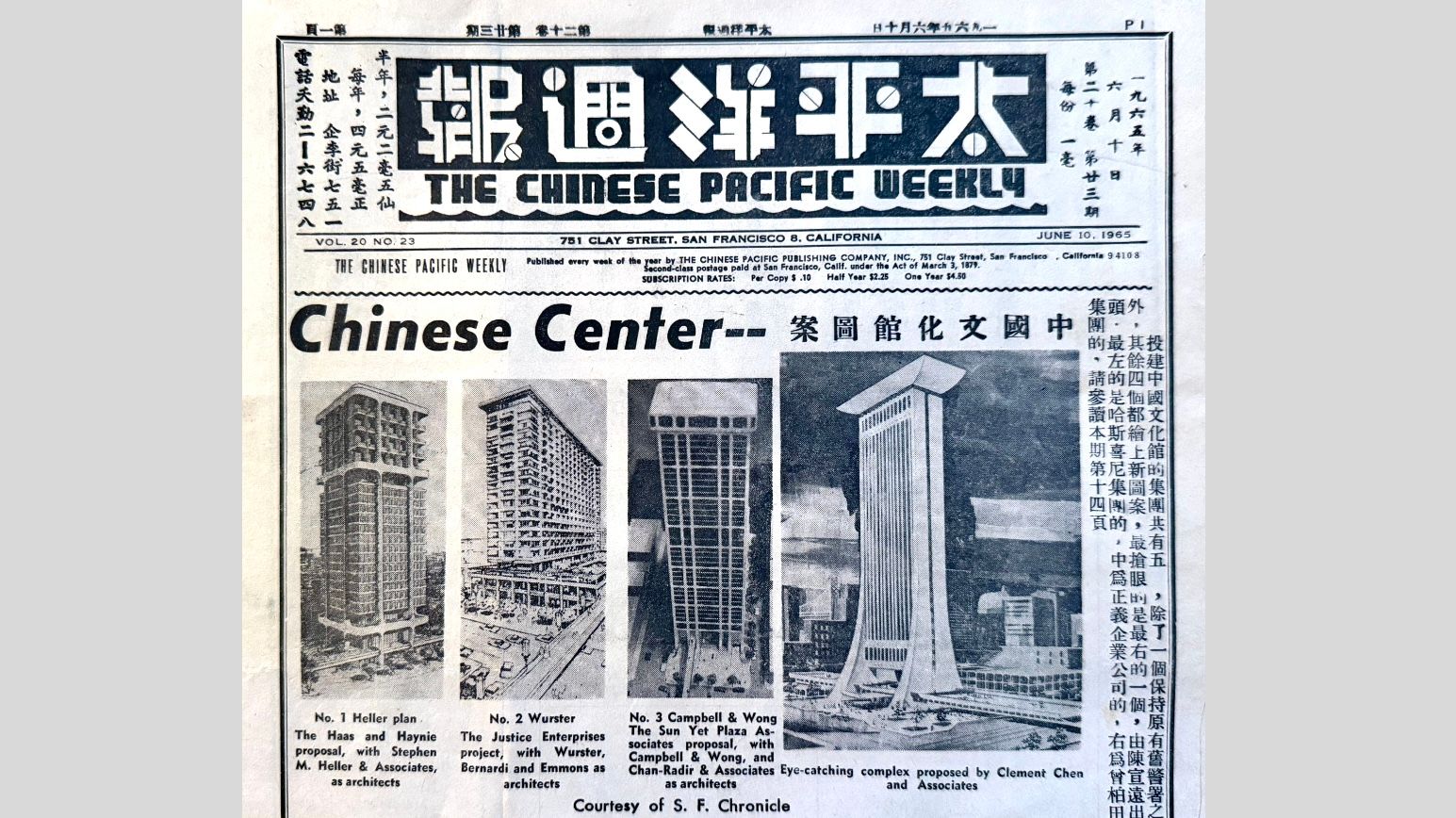
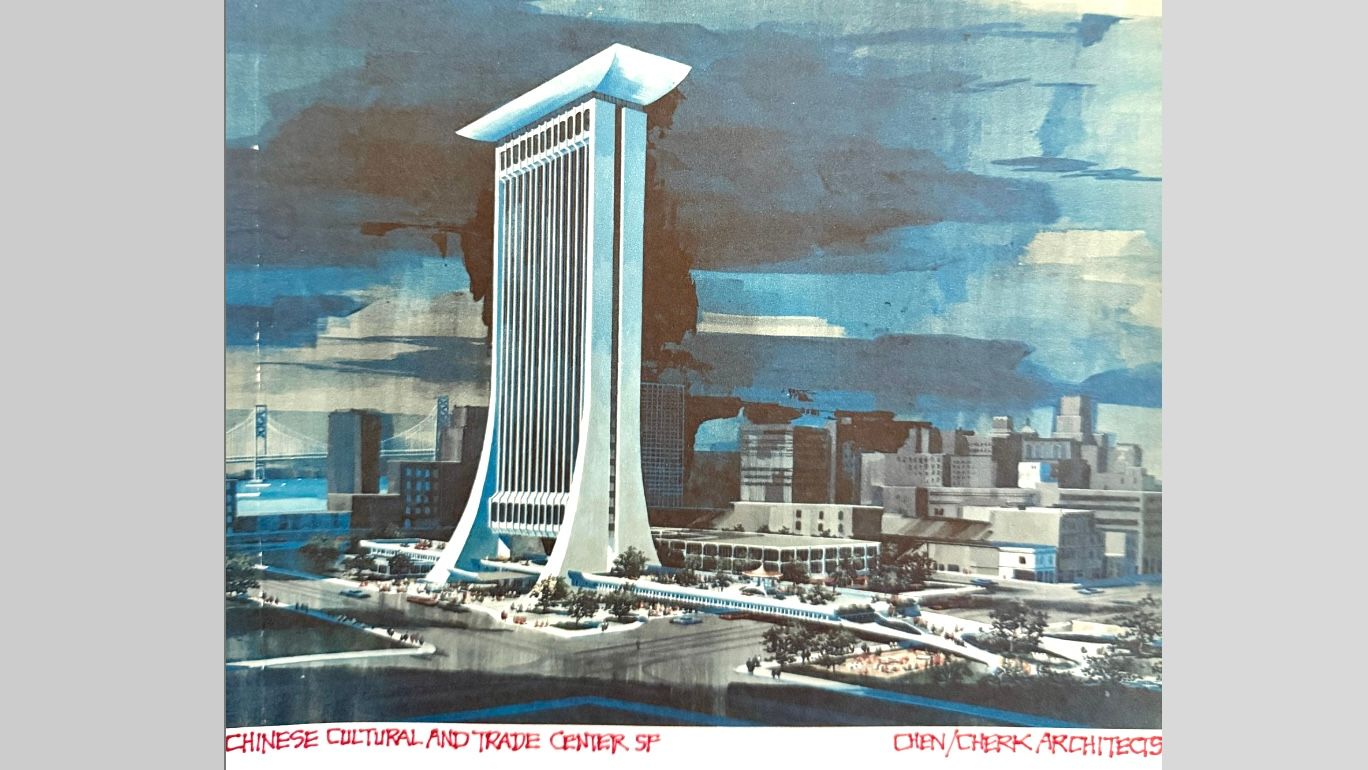
After Cherk's firm was established, Clement Chen, who was born in Shanghai and trained as an architect in New York, also started his architectural firm in 1964. Chen invited Cherk to submit a proposal together working as a team to bid for the City's contract to transform the old Hall of Justice site into a "Chinese Cultural and Trade Center".
Chen played a role of developer in the bidding process. Chen/Cherk's team was ultimately selected by the City’s Redevelopment Agency among five bidders/proposals.
"He[Chen] partnered with me to enter the competition to visualize a new use of the old Hall of Justice site," Cherk recalled. "We were a good team. He made the contacts (the outside man), I dreamt up the plans (the inside man). Of course he contributed to the thinking when he wasn't on the phone."
"It was our joint solution that intrigued the Redevelopment Agency," Cherk said, very proud of their success in winning the first contract for developing Chinatown after the Chinese Exclusion Act ended.
The idea of establishing the "Chinese Cultural and Trade Center" in the early 1960s marked the first successful advocacy effort organized by the Chinese community to expand the Chinatown boundary beyond the line of Kearny Street after the Chinese Exclusion Act was repealed by Congress in 1943.
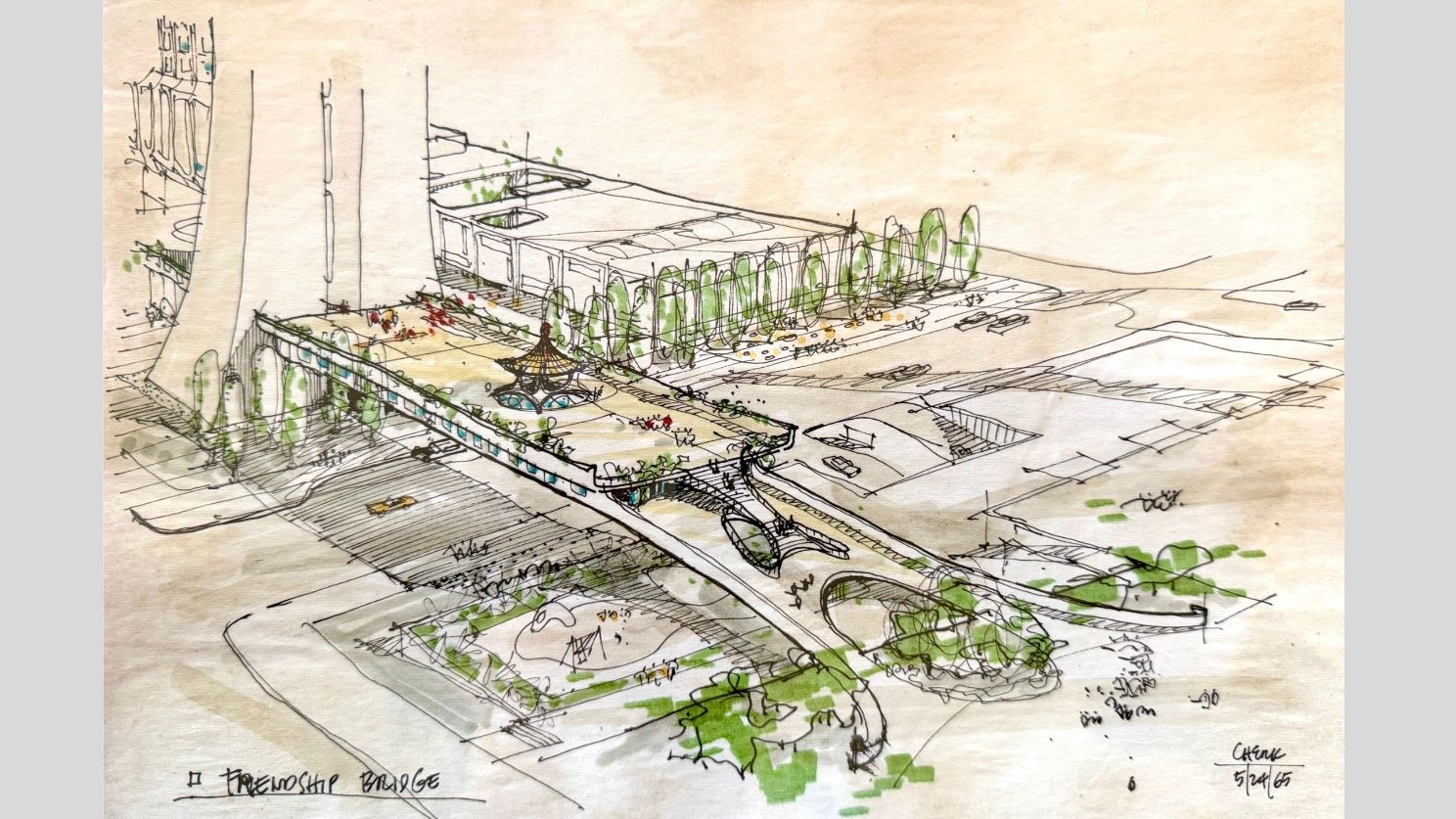
The pedestrian bridge connecting Portsmouth Square to the Chinese Culture Center and spanning Kearny Street was a major component of the "Chinese Cultural and Trade Center" project. The project was later changed to become the "Holiday Inn Hotel and Chinese Culture Center."
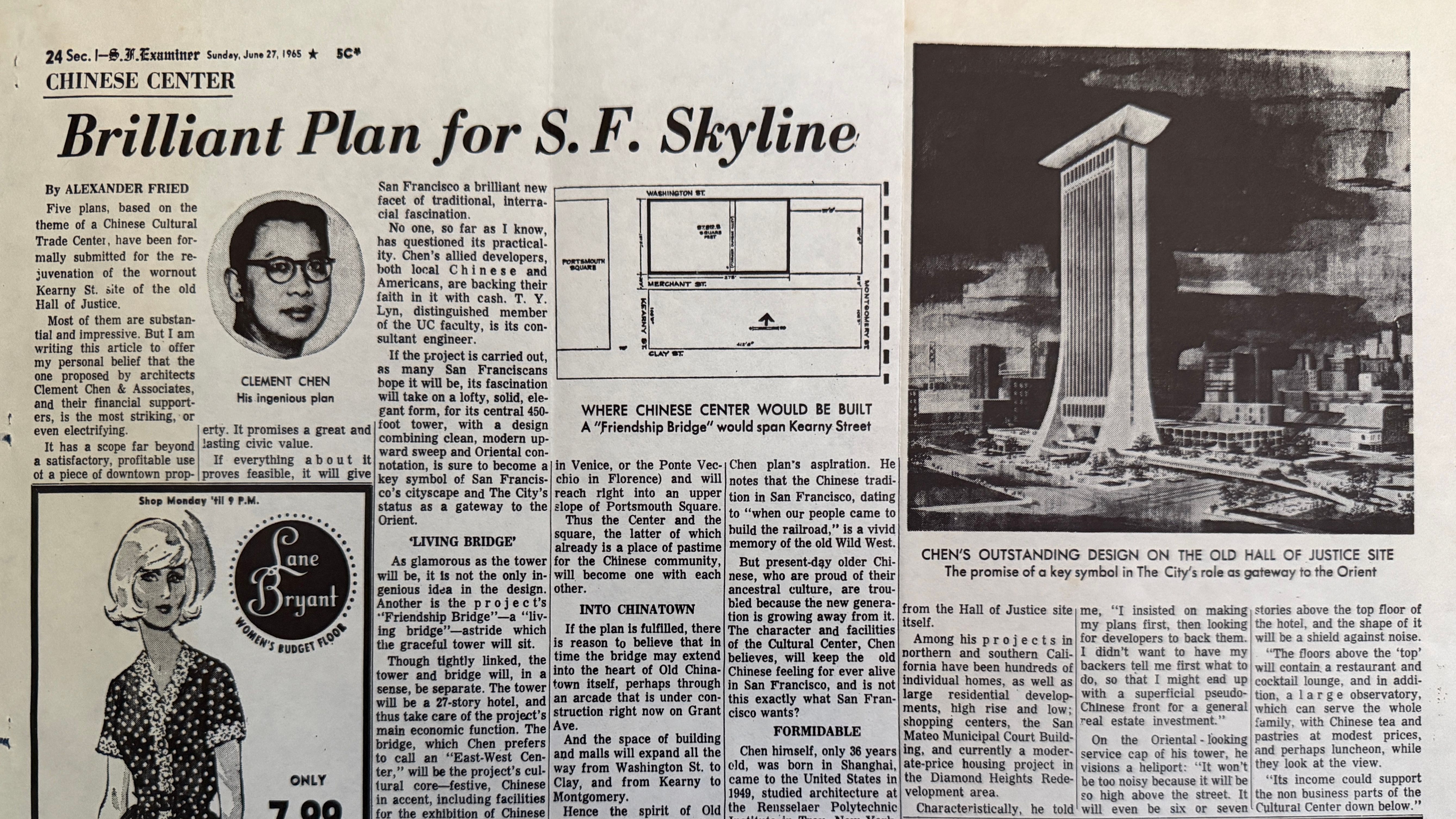
The current Hilton Hotel was formerly a Holiday Inn when it was first built. Cherk was the actual architectural designer of both the hotel and the bridge. Chen was responsible for operation and administration.
Cherk said the Chinatown community initially lobbied the City to re-develop the Old Hall of Justice site as a Chinese Culture Center. After intensive advocacy, the City first agreed with the plan and later approved selling the land to the Holiday Inn with the Culture Center housed on the third floor.
Both the Holiday Inn and the pedestrian bridge opened in 1971. The bridge has since become a Chinatown landmark for over half a century.
In addition to its uniqueness in design and structure, the 28-foot wide and 240-foot long bridge stood strong and firm during the magnitude 6.9 Loma Prieta earthquake in 1989 with no damage at all.
World-renowned Chinese American bridge-building structural engineer Tung-Yen Lin (T.Y. Lin), who was a pioneer of standardizing prestressed concrete in practical use, joined in building the Portsmouth pedestrian bridge in late 1960s.
Cherk said the bridge has been historically significant to the Chinese community and the civil rights movements in San Francisco. He called it an "East and West Bridge" when he designed it in 1965.
Cherk disagreed with building the 8,500-square-foot clubhouse which led to the City's approval to remove the bridge for more space to accommodate it.
"That clubhouse removes too much usable space from a public park," Cherk said. "This idea has a negative environmental impact on any parks which are designed for open spaces. You can't find any squares or parks in San Francisco that have such a big clubhouse, such as Union Square and Washington Square."
"A clubhouse should be housed in a building, not a park," Cherk said in his professional view as a lifelong architect who is still practicing up to this date.
Another unjust chapter of San Francisco for ignoring the larger Chinese community and claiming no opposition known with support from nonprofits to erase Chinatown's legacy and history
"The Portsmouth Square pedestrian bridge is a prominent architectural landmark in Chinatown, San Francisco, that spans over Kearny Street from Portsmouth Square to the second and third floors of the Hilton San Frnacisco Financial District hotel, which houses the Chinese Culture Center of San Francisco," Wikipedia noted.
"Nevertheless, its brutalist architectural elements and banked sides have made it an attractive space for street skateboarders, from whom it has seen continuous use since the late 1970s, and has been a mainstay in skate media," Wikipedia added.
The 28-foot wide and 240-foot long Portsmouth Square bridge in San Francisco Chinatown is very unique and historic as it also has become one of the very few pedestrian bridges built in the downtown of any metro cities.
According to the City's documents, The Portsmouth Square Improvement Project managed by the City's Recreation and Parks Department will 1) renovate Portsmouth Square with a new children’s playground, exercise equipment, shade structures, seating areas, wayfinding, signage, sidewalks, landscaping, terraces, ramps, and a new 8,500- square-foot clubhouse; 2) demolish and remove the pedestrian bridge spanning Kearny Street that connects Portsmouth Square to the Hilton Hotel; 3) re-waterproof the roof of the Portsmouth Square Garage located underneath the park and portions of the adjacent streets and sidewalks and seismically upgrade portions of the parking garage; and 4) replace curb cuts and a portion of the streets and sidewalks adjacent to Portsmouth Square.
The bridge's removal was primarily to provide space for the much bigger 8,500-square-foot clubhouse, which Self-Help for the Elderly plans to manage.
The Recreation and Parks Department revealed that 77% of Chinatown residents in surveys responded that they never used the bridge and supported its removal. In fact, the surveys were mostly circulated among the nonprofit organizations.
The City's documents also indicated that the public comment period for the draft Environmental Impact Report (EIR) of the Portsmouth Square Improvement Project ended on September 20, 2021 amid the pandemic.
Although the City's Planning Department recommended in a 455-page report in 2021 to fully- or partially- preserve the historic pedestrian bridge because the removal of the bridge "would cause a significant and unavoidable impact to identified historic resources." The City did not take steps to consider alternatives to preserve the bridge.
On January 13, 2022, the San Francisco Planning Commission approved the improvement project which included tearing down the pedestrian bridge spanning Kearny Street that connects Portsmouth Square to the Chinese Culture Center on the third floor of the Hilton Hotel.
Four speakers who appeared in the Planning Commission's January 13, 2022 meeting in support of the project and removing the bridge were Allan Low, Amy Chung, Karen Chan and Amy Zhou, all affiliated with the Chinatown Community Development Center (CCDC), a nonprofit housing organization headquartered in Chinatown. Low, a private attorney specializing in land use, is a former member of the City's Recreation and Park Commission and a pro bono lawyer for CCDC.
In 2022, the Recreation and Parks Commission and the Board of Supervisors subsequently approved the Portsmouth Square Improvement Project, which included demolishing the bridge.
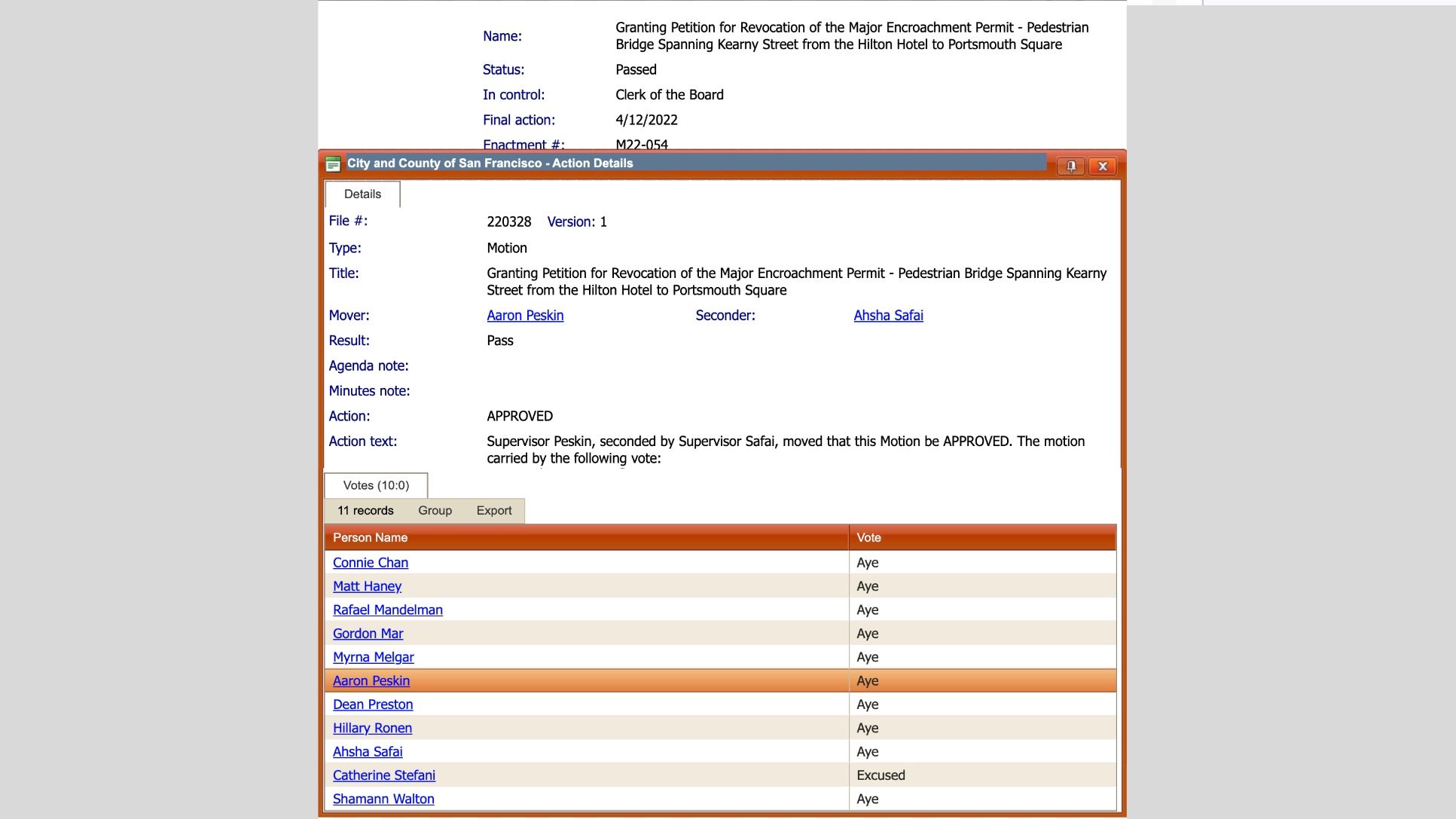
On April 12, 2022, The Board of Supervisors voted 10:0 to approve a "petition for revocation of the major encroachment permit - pedestrian bridge spanning Kearny Street from the Hilton Hotel to Portsmouth Square." The petition was proposed by Supervisor Aaron Peskin and seconded by Supervisor Ahsha Safai.
Then Supervisor and now Assemblymember Catherine Stefani was the lone Supervisor excused from the vote. All other 10 Supervisors including two Chinese Americans, Connie Chan and Gordon Mar, voted in favor of the "petition" initiated by Peskin to revoke the "major encroachment permit" - Portsmouth Square pedestrian bridge.
The petition authored by Peskin indicated that he demanded an official cancellation of a permit issued by the City in 1965 regarding a major fixture placed on public land or street.
In other words, the 10:0 passage of Peskin's "petition" at the Board of Supervisors authorized the demolition of the pedestrian bridge and revoked the permit granted to the Chinese community to build the Portsmouth Square pedestrian bridge in the early 1960s.
Wind Newspaper first covered the overwhelming opposition from leaders and members of the Chinese community outside the nonprofit community in a news report published in June 2025 a year ago.
Among the opponents interviewed by the Wind Newspaper were prominent community leader Thomas Ng, a respected leader of the Chinese Consolidated Benevolent Association (CCBA) as "Mayor of San Francisco Chinatown"; Robert Chiang, a long-time leader of both the CCBA and the Chinese Chamber of Commerce; Ding Lee, an Elder of the Lee Family Association and Director of the Historical and Cultural Committee at CCBA; Sam Kwong, an architect based in Chinatown and leader of the Chinese American Democratic Association; and Albert Chang, owner of the Chinatown Kite Shop for over 50 years and a former Republican Party leader.
Ng, a board member of CCBA for five decades and a lifelong resident of Chinatown, confirmed that no one from the City or nonprofits ever informed him or the CCBA about the plan to demolish the bridge.
Chang, a merchant at the kite shop on Grant Avenue for over 50 years, did not know about the proposed demolition of the bridge until he read about it in the news.
The Portsmouth Square renovation project had not moved forward significantly until January 2026, when bids for construction re-opened. In February 2026, the City informed the Recreation and Parks Commission that the project was intended to be awarded to Swinerton Builders.
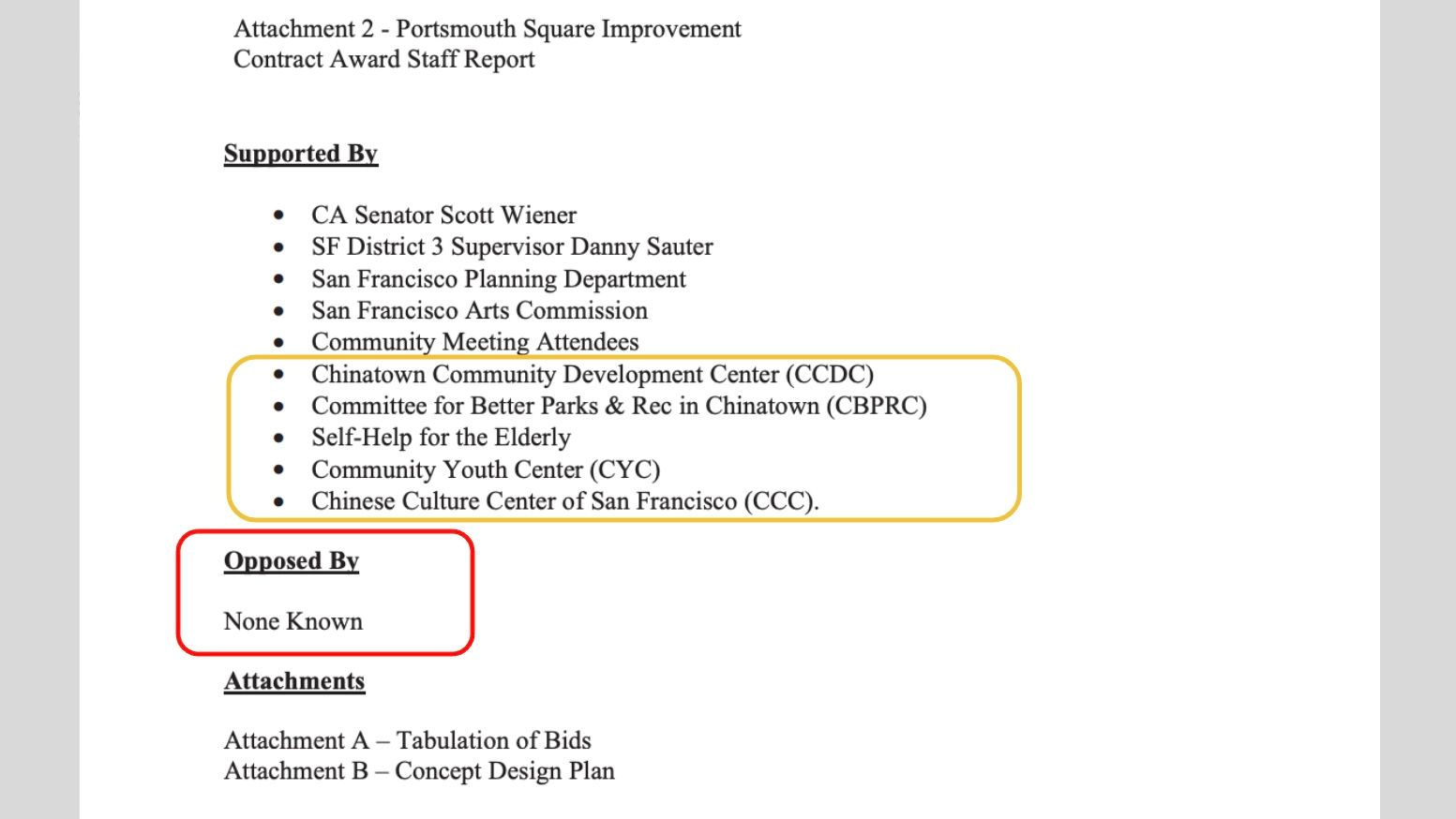
In City's reports released in February and March 2026, four nonprofit organizations, which provide social services to the Chinese community, were repeatedly listed as supporters of the Portsmouth Square Improvement Project including the demolition of the pedestrian bridge. Those four nonprofits are the Chinatown Community Development Center (CCDC), Self-Help for the Elderly, the Chinese Culture Center of San Francisco (CCC), and Community Youth Center (CYC).
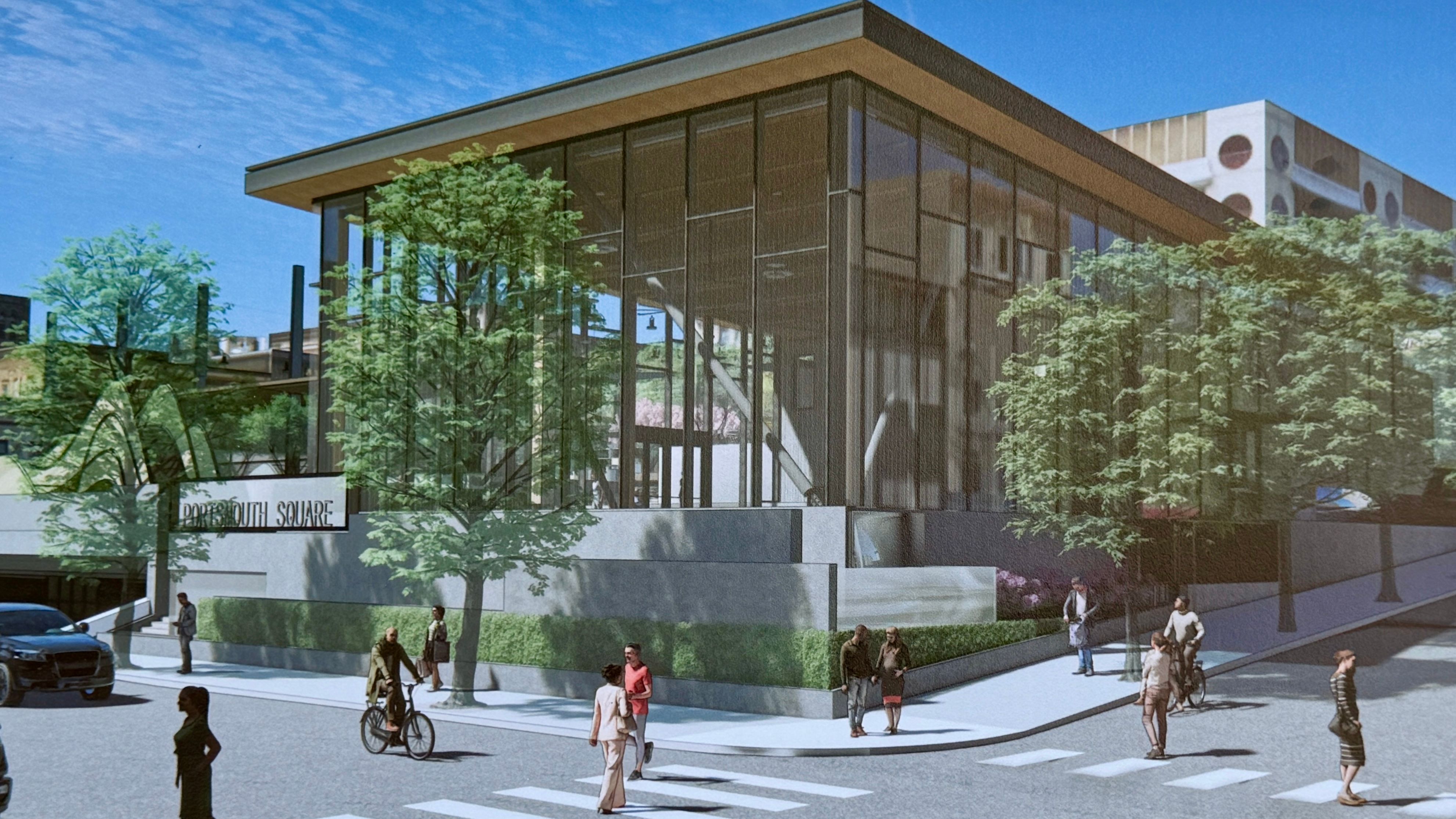
However, the Recreation and Parks Department stated in its reports that there was "No opposition known". Community members were shocked to find this dishonest and incorrect information in City's official documents.
The Portsmouth Square Improvement Project was approved under the administration of former Mayor London Breed and has been managed under Mayor Daniel Lurie since 2025. Wind Newspapers had sent inquiries to Lurie's Office, District 3 Supervisor Danny Sauter who represents Chinatown, and multiple city agencies in 2025 and 2026. The City should have heard of the community's different voices beyond the nonprofit organizations.
4 nonprofits received millions of dollars in public funds to acquire their permanent homes in recent years
In the meantime, the City has provided significant public funds to these four nonprofits every year and also awarded millions of dollars to them for acquiring new permanent homes or service centers in recent years after the Portsmouth Square Improvement Project passed in 2021 or 2022.
1) Chinatown Community Development Center (CCDC) received an award from former Mayor London Breed in 2022 under the San Francisco Nonprofit Sustainability Initiative (NSI) for its headquarters at 615 Grant Avenue in Chinatown.
"With the support of NSI, CCDC is purchasing 615 Grant Avenue to provide 18,380 square feet of modern office space for its staff to work more effectively," Breed announced in a press release on March 24, 2022.
2) Self Help for the Elderly (SHE) received a $4.1 million grant from Breed in 2023 for a senior care facility at 933 Clement Street in the Richmond District. Breed made the announcement on November 8, 2023.
"The acquisition of the property was supported by a $4.1 million grant secured through a competitive request for proposals process through the Mayor’s Office of Housing and Community Development (MOHCD). Assemblymember Phil Ting secured an additional $2.1 million in funding from the State of California. Once the project is complete, the Department of Disability and Aging Services will provide SHE with operating subsidies of $400,000 annually for community services for seniors," Breed announced in a press release.
3) Chinese Culture Center (CCC) announced on January 12, 2024 with Breed the acquisition of a new headquarter at 667 Grant Ave in Chinatown by public funds.
The acquisition of the entire property at 667 Grant was funded by a $4.7 million grant secured through the Mayor’s Office of Housing and Community Development (MOHCD) as part of the API Equity Fund championed by Supervisor Connie Chan, co-sponsored by former Supervisors Aaron Peskin and Gordon Mar. Former Assemblymember Phil Ting and Assemblymember Matt Haney additionally secured $1 million from the State of California for renovations to transform the storefront into an exhibition space, artist studio, and community gathering hub, according to the Chinese Culture Center.
4) Community Youth Center (CYC) announced on November 10, 2021 the acquisition of a building at 952 Clement Street as a new center with expansion in services in the Richmond District secured by the $2.5 million State funds.
“CYC has done extraordinary work for the Richmond. I was happy to be their champion in Sacramento, securing $2.5 million in state funding for their new center. This investment will ensure the organization’s impact will be felt for generations to come,” said Ting in the press release. Breed said the Mayor’s Office of Housing and Community Development (MOHCD) partnered with the State to help establish the permanent home for CYC.
Malcolm Yeung, CEO of CCDC, said in the press release on June 9 to celebrate the groundbreaking for the Portsmouth Square renovation project, “In the densest residential community in San Francisco, where 60% of our housing are SRO’s, Portsmouth Square is a literal and figurative community living room. That’s why this community has engaged and advocated for this reimagining of our living room for over 15 year."
“I am grateful to the thousands of Chinatown residents and stakeholders for engaging, for struggling (sometimes with each other), and for advocating to make this reimagination a reality. And I want to thank Rec & Park and all of our city agencies for partnering with us along the way,” Yeung noted.
“Our seniors have been waiting for a long time for a modernized, functional Portsmouth Square Park and Community Center." Ann Chung, Executive Director of Self-Help for the Elderly, noted in the same press release. “Today’s groundbreaking ceremony fills our hearts with joy, telling us the new park will be ready soon. We look forward to working closely with the Rec and Park staff to transform Portsmouth Square into the most visited and beautiful park that our community deserves.”
Community members: Does Mayor Lurie put state funding above the bridge’s historical significance to the Chinese community?
Since Mayor Lurie took office in January 2025, community leaders and Wind Newspaper have forwarded their opposition to tearing down the pedestrian bridge to Lurie.
Lurie responded to both community members and Wind Newspaper in the same tone. “Portsmouth Square serves not just as a vital community hub for the Chinatown community, it is a welcoming site for visitors from across San Francisco and around the world. For decades, this square has served as the living room of Chinatown and we are making sure it receives the investment it deserves to be a clean, safe, and welcoming space for the neighborhood for decades to come.”
“To ensure that we don’t lose crucial state funding to bring this project to life, our office is working closely with community members to move the project forward. This administration remains committed to fostering strong collaboration among City departments and keeping the community informed every step of the way," Lurie responded to Wind Newspaper's inquiry in 2025.
"Does Mayor Lurie put state funding over the bridge’s historic significance to the Chinese community?" The larger community members from family associations, merchants and residents asked.
- Prop G gets a second chance for San Francisco voters to decide the fate of the Upper Great Highway in the November election
- 23 parking spaces during commute hours added in Chinatown amid 3 major renovation projects
- Asian supermarkets are booming in the San Francisco Bay Area with intense industry competition
- Architect Dartmond Cherk: Taking away this symbolic bridge would deflate the standing of the Chinese community in San Francisco
- Our Mission and Policy
- San Francisco: Kearny Street, between Clay and Washington streets, to be fully closed Aug. 1-2 and Aug. 8-9; Broadway Tunnel closed Aug. 15-16
- Carla Lee Hurley and Kirk Yin, 2 bilingual and community-oriented police officers, promoted to Captains in SFPD
- Over 15,000 signatures submitted, San Francisco citywide voters might have a chance to reopen Upper Great Highway