14 California propositions including measures to impose Billionaire Tax and ban future wealth tax to be decided by statewide voters

SAN FRANCISCO — California voters will determine the outcome of 14 statewide ballot measures in the November 3 election, including the nationally-watched Proposition 40 which will impose a one-time 5% wealth tax on any Californian whose assets are over $1 billion.
Voters in California have received one of the longest ballots in recent years in the mail with 14 state ballot measures in addition to the Governor and other races running for the state constitutional officers.
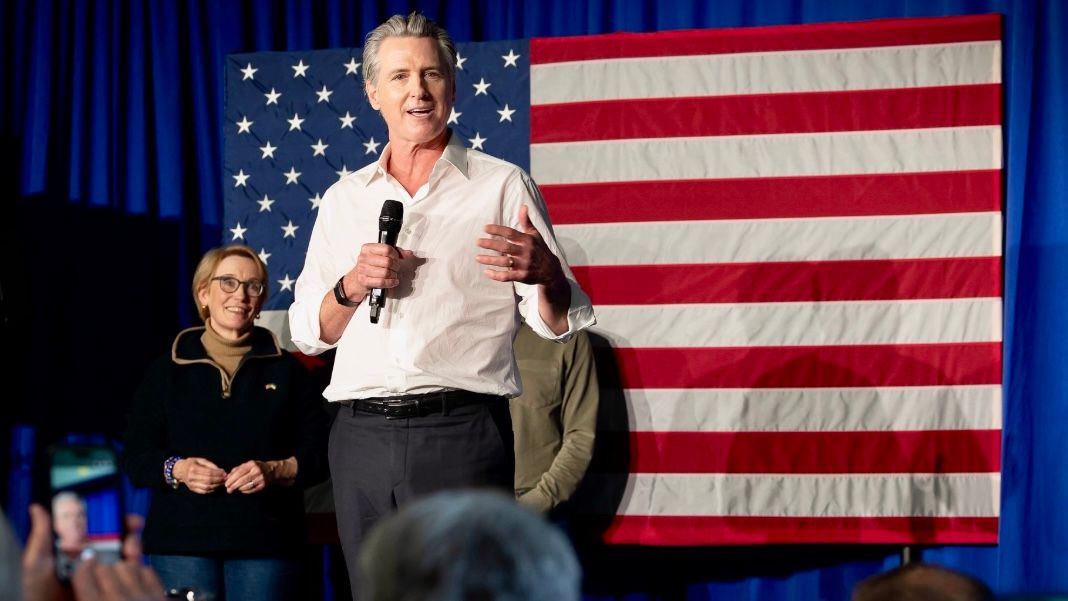
Among the 14 California ballot measures, Prop 40, the so-called "California Billionaire Tax", is the most divided among Californians. Governor Gavin Newsom has been one of the most vocal opponents of Prop 40.
According to Prop 40, if the measure is approved by the majority of California voters, the state will impose a one-time tax of up to 5% on California taxpayers with covered assets valued over $1 billion. The covered assets include businesses, securities, art, collectibles, and intellectual property, but exclude real property and some pensions and retirement accounts.
Prop 40 was proposed by labor unions. Supporters of Prop 40 including Suzanne Jimenez, Chief of Staff of the SEIU-United Healthcare Workers West, said in the argument that President Donald Trump slashed funding for healthcare in California to pay for more billionaire tax breaks. As a result, a million Californians lose their health coverage and other millions Californians need to pay double their health insurance premiums.
"Vote yes on Prop 40 to make billionaires finally pay their fair share in taxes and stop sticking the middle class with the bill," Jimenez wrote.
It is estimated approximately 200 Californians will pay the 5% wealth tax if Prop 40 is approved in the election. The tax would be retroactive and apply to taxpayers residing in the state as of January 1, 2026. The tax would be due with an individual's 2027 tax filings.
The initiative would create the 2026 Billionaire Tax Reserve Fund. The revenue from Prop 40 would fund Medi-Cal and other health coverage programs for low- and moderate-income individuals; public education from K-14; and food assistance programs such as CalFresh.
Newsom opposed Prop 40 and said, "We can’t let a single advocacy organization, however well-intentioned, write the state’s tax code on its own terms. We make those decisions together through the elected Legislature, through a budget, and through the public process that voters built precisely to prevent any single interest from prevailing with disregard for the rest."
"At the same time, the fight to make the wealthiest Americans pay more in taxes is not one we should be fighting state by state. You may not be able to pick up and move to Texas or Florida to shelter your income from taxation, but I promise you that billionaires can, and do," Newsom said.
"Wealth is movable, and it shops for the state with the lowest taxes. The fight belongs at the federal level, where this broken system was created in the first place," Newsom stated.
Members of the Chinese community tend to oppose Prop 40. Chinese American Democratic Club (CADC) in San Francisco, founded in 1958 as the oldest Democratic Party affiliation for Chinese Americans across the nation, has voted against the initiative.
"CADC opposes Prop. 40 because taxing unrealized wealth and difficult-to-value assets could be administratively complicated and could encourage high-income residents and entrepreneurs to relocate, potentially reducing California's future income-tax base," CADC said in the rationale.
Prop 42, which is the competing ballot measure of Prop 40, prohibits any new state tax imposed on the ownership of personal property or control of retirement holdings, pension, 401K accounts, IRAs and other forms of personal savings. The initiative would also prohibit retroactive taxes that authorize a tax on conduct, activities, or status that occurred or was present prior to the effective date of the state law or constitution.
If both Prop 40 and Prop 42 are approved by California voters, either initiative would nullify the other one that depends on which one receives more votes than the other.
Supporters of Prop. 42 include California Professional Firefighters President Darrell Roberts, State Building and Construction Trades Council of California President Chris Hannan, and Peace Officers Research Association of California President Brain R. Marvel.
"Prop 42 protects the retirement and savings for all Californians—young workers just beginning to save; teachers, firefighters and police officers with pensions; retirees and veterans who depend on their savings for financial security. You saved it. You deserve to keep it," Roberts, Hannan and Marvel said in a joint statement filed with the California Secretary of State Office. "If you think your retirement and savings should be protected from taxes, vote yes on Prop 42."
Newsom endorses Prop 42 and said in a statement, “We all agree that Californians deserve to have their retirement and life savings protected from new state taxes so those savings are there when they need them.”
CADC supports Prop 42 and commented, "It establishes a constitutional limit against new wealth or asset taxes and retroactive taxation. It also directly conflicts with Prop. 40's proposed billionaire wealth tax."
The summary of 14 state ballot propositions follows:
Proposition 1: Authorizes bonds for housing affordability programs (legislative statute)
Prop 1 authorizes $11.25 billion in state general obligation bonds for housing affordability programs, including multifamily rental housing, mortgages for veterans, supportive housing, preservation of existing affordable housing, and downpayment assistance. The measure would increased state cost of $500 million to $600 million annually for about 25 years to repay the housing bond.
Proposition 2: Increase state’s rainy day fund (legislative constitutional amendment)
Prop 2 increases California's Rainy Day Fund, approved by voters in 2014, to provide funding for education, health care, public safety, and other essential services during economic downturns. The budget reserve cap would be doubled from 10% to 20% of the General Fund revenues, requiring savings until reaching 20% of the Fund.
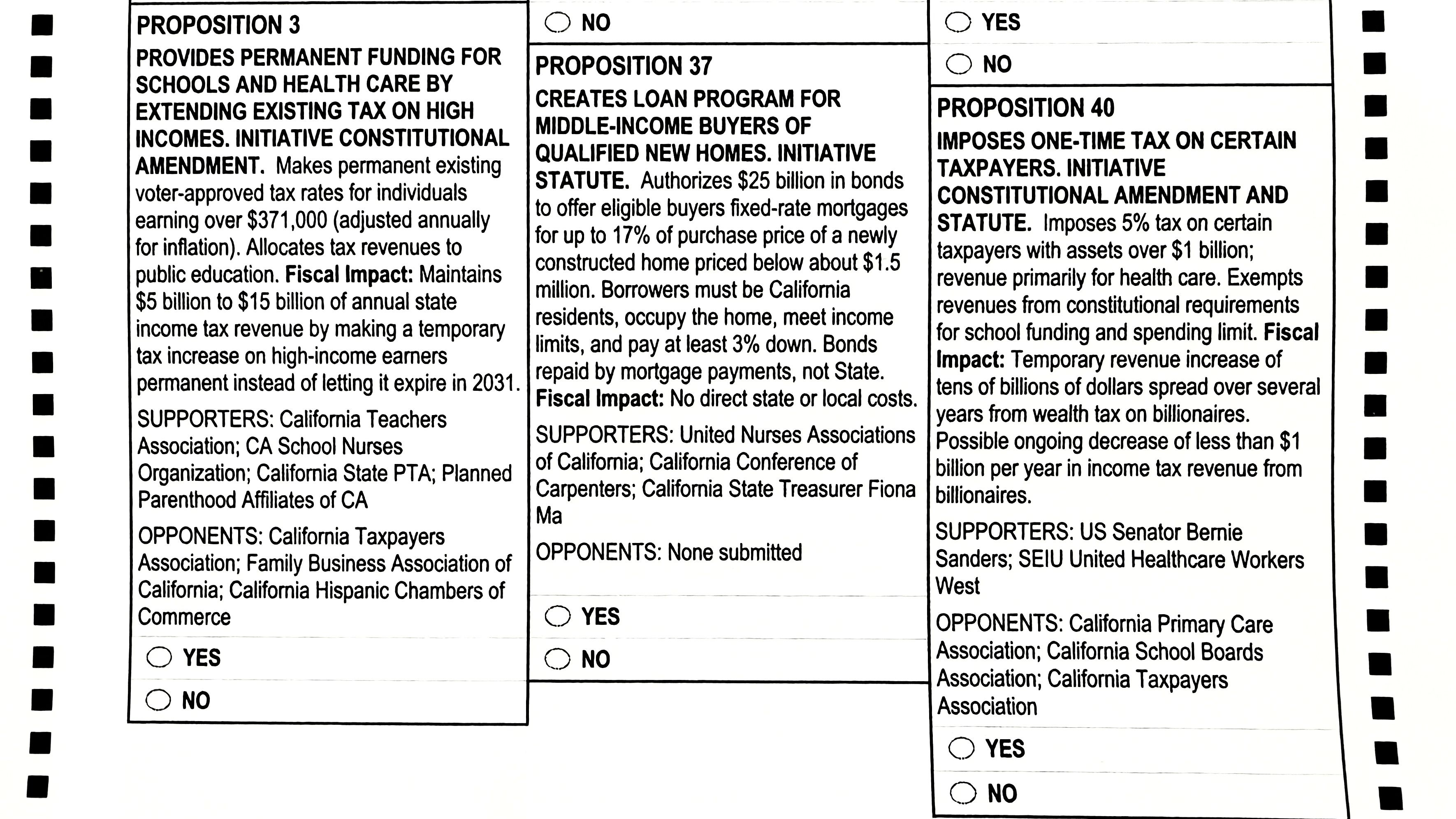
Proposition 3: Provides permanent funding for schools and health care by extending existing tax on high incomes (initiative constitutional amendment)
Prop 3 makes permanent existing voter-approved tax rates for individuals earning over $371,000 (adjusted annually for inflation) and allocates tax revenues to public education.
Proposition 4: Repeals prohibition against public funding of election campaigns (legislative statute)
Prop 4 repeals prohibition on state and local governments offering public funding of candidate election campaigns. Public funding programs may not use funds earmarked for education, transportation, or public safety.
Proposition 5: Changes recall election process for statewide officers (legislative constitutional amendment)
Prop 5 proposes to change current law, voters elect replacement candidates at the same time as the recall election. This measure instead fills recall vacancies by subsequent special election or appointment.
Proposition 37: Creates loan program for middle-income buyers of qualified new homes(legislative statute)
Prop 37 authorizes $25 billion in bonds to offer eligible buyers fixed-rate mortgages for up to 17% of purchase price of a newly constructed home priced below about $1.5 million. Borrowers must be California residents, occupy the home, meet income limits, and pay at least 3% down. Bonds are repaid by mortgage payments, not State.
Proposition 38: Authorize bonds for immunology medical research (initiative statute)
Prop 38 authorizes $8.4 billion in general obligation bonds for immunology and immunotherapy research, half to a single University of California-affiliated nonprofit medical research institute, half to research grants.
Proposition 39: Prohibits citizens from voting unless they present government-issued identification (initiative constitutional amendment)
Prop 39 invalidates mail ballots that do not have the last four digits of designated government-issued identification number written on the envelope. Prohibits in-person voting without presenting government-issued identification.
Proposition 40: Imposes one-time wealth tax on certain taxpayers (initiative constitutional amendment and statute)
Prop 40 imposes 5% tax on certain taxpayers with assets over $1 billion. The revenue is primarily for health care. Exempts revenues from constitutional requirements for school funding and spending limit.
Proposition 41: Prohibits new state taxes that exclude revenues from state spending limit. Requires audits for new state special taxes (initiative constitutional amendment)
Prop 41 nullifies state taxes enacted after January 1, 2026 that exempt their revenues from voter-approved state spending limits. Requires pre-election and recurring audits of programs funded by new special taxes.
Proposition 42: Prohibits new state personal property taxes and certain retroactive state taxes (initiative constitutional amendment)
Prop 42 prohibits any new state tax imposed on the ownership of personal property, or applies retroactively based on taxpayer’s past activities. Nullifies taxes enacted after January 1, 2026 that conflict with this measure.
Proposition 43: Limits voters’ ability to raise revenues for local government services (legislative constitutional amendment)
Prop 43 limits voters’ ability to pass voter-proposed local special taxes by increasing the percentage of votes needed to approve such ballot measures from a majority (over 50%) to two-thirds, beginning January 1, 2027.
Proposition 44: Requires community health clinics spend 90% of revenue on program services (initiative statute)
Prop 44 imposes penalties on nonprofit Federally Qualified Health Centers (community clinics providing primary care to medically underserved areas and populations) that spend less than 90% of revenue on “program services” advancing their charitable purpose, including but not limited to patient services.
Proposition 45: Modifies environmental review for certain projects (initiative statute)
Prop 45 amends California Environmental Quality Act (CEQA) to expedite environmental review for certain projects (including most housing, transportation, water, and health projects) by setting deadlines to complete environmental review and resolve lawsuits challenging project approvals.
- Chinese community members say Prop H unfairly makes property owners pay for the San Francisco public transit agency’s shortfalls
- Proposition B authored by Supervisor Chen to create a Public Bank in San Francisco faces mounting opposition
- Opinion: City College opened doors for my family. Let’s keep them open.
- Opinion: Share the Great Highway. Keep San Francisco inclusive. Yes on G.
- A pre-election national AAPI poll: More AAPI adults trust Democrats over Republicans in handling issues
- Opinion: Opposition to Prop H should not be met with threats to eliminate 19 bus routes
- 14 California propositions including measures to impose Billionaire Tax and ban future wealth tax to be decided by statewide voters
- Voters in 5 counties of the San Francisco Bay Area to decide whether to raise the sales tax by 0.5% or 1% for 14 years to fund public transit